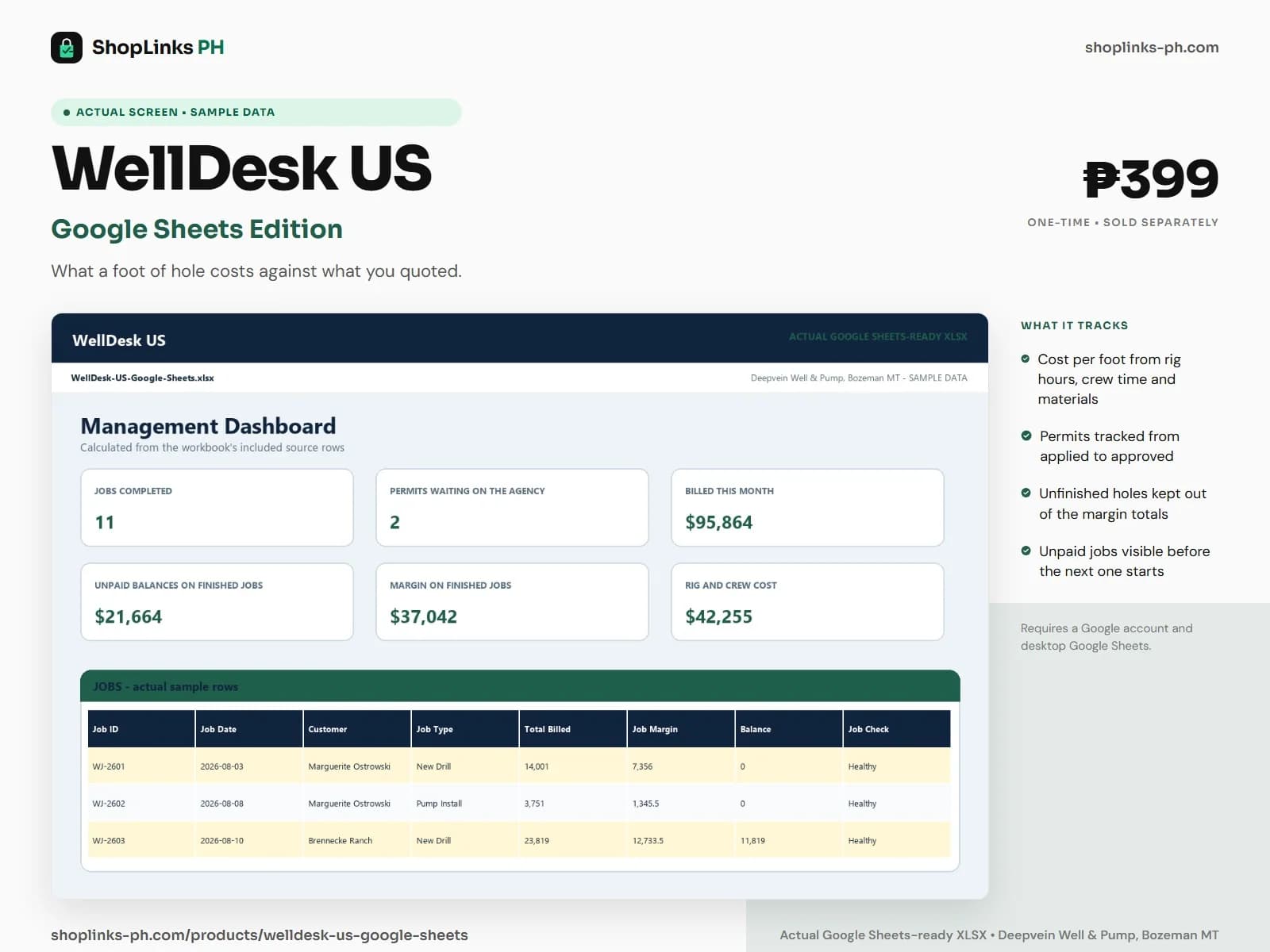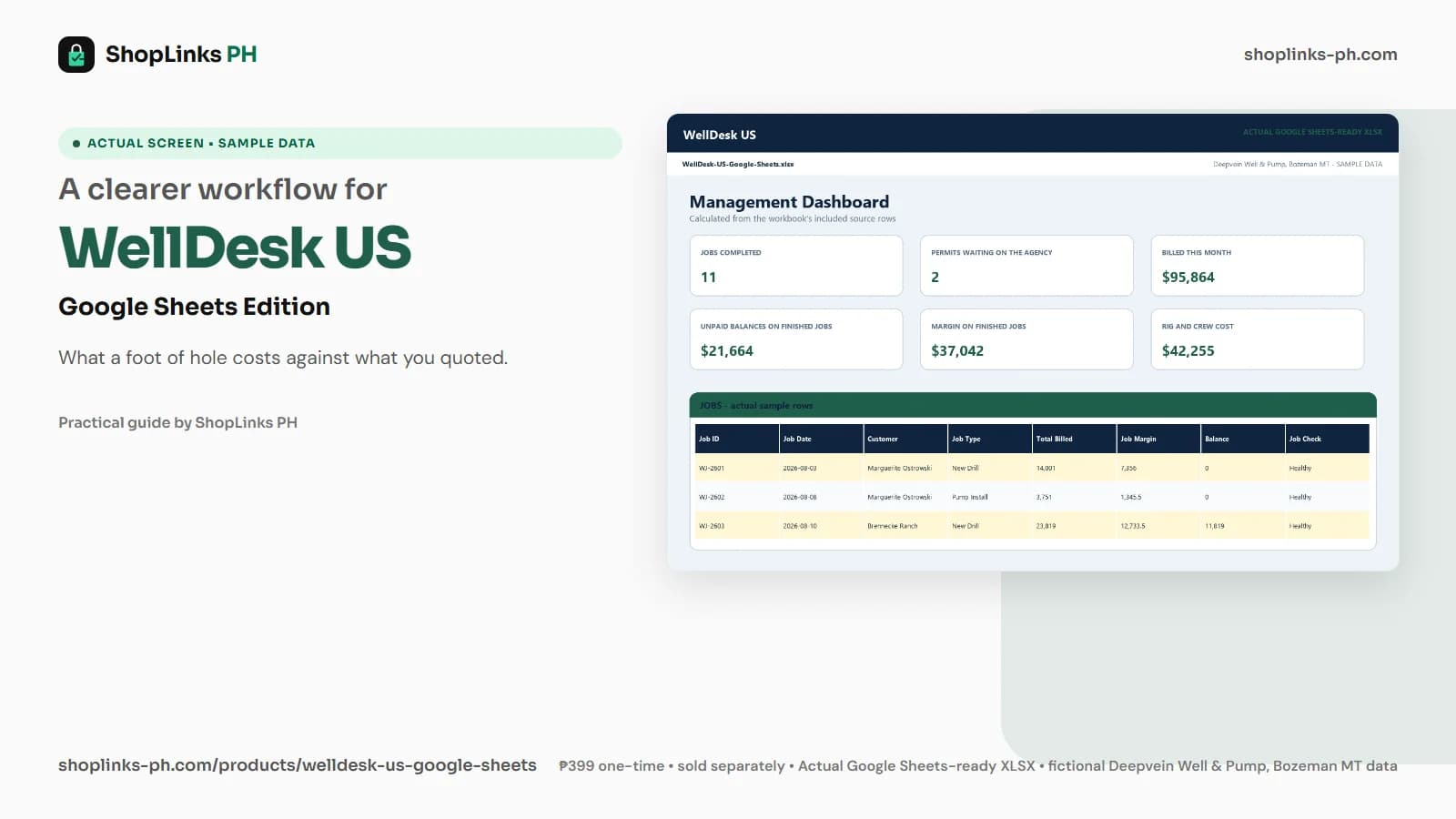
Key takeaways
- Footage billed derives from the rate per foot.
- Every rig carries its own hourly operating cost.
- Cost per foot checks the quote against reality.
- Open holes are labelled In progress, not profit.
Deepvein Well & Pump quotes thirty eight dollars a foot on soft ground and forty four where the air hammer is needed. In August the crew drilled five holes, set four pumps and decommissioned an old district bore. The invoices went out, the money mostly came in, and nobody in the shop could say which of those jobs paid for the rig hours it burned or what the hard rock section on the ranch really cost.
Billing starts at the footage
A job records the footage drilled and the rate per foot, and the footage billed derives from the two. The service charge covers a pump set or a repair, the materials billed come off the lines, and the permit fee is added where you billed one.
Nothing on the invoice is typed twice. Change the rate or add a length of casing and the total moves with it, so the number the customer sees and the number in the register are always the same number.
Rig hours are the hidden cost
Each rig carries its own hourly operating cost, because an air hammer burning compressor fuel is not the same machine as a rotary rig or a pump hoist truck. Rig hours times that rate is the first line of job cost.
Crew time is logged per person at that person's hourly rate, and the material lines carry both a cost and a sell price. Add the three and you have what the hole cost before anybody argues about it.
Cost per foot against the quote
Cost per foot is the job cost divided by the footage drilled. Set it next to the rate per foot you quoted and the pricing conversation stops being a matter of opinion for the first time.
A shallow hole on soft ground and a deep bore through hard rock can both be profitable at different rates, and they can both lose money at the same one. The register tells you which of those you are living in.
Open holes are not profit
A job that is still open reads In progress. It stays out of the margin totals and out of the dashboard, because a hole billed at progress but not yet fully costed reads as the best job of the month and is not.
The well summary counts only completed jobs, so a well with a rig still sitting on it shows In progress until the work is closed, and the margin you read is margin you actually earned.
Review exceptions every week
Resolve duplicate IDs, missing links, overdue balances, negative amounts, and open operational items in CHECKS before using the dashboard for decisions.
WellDesk US Google Sheets Edition is designed for use with a Google account and current desktop Google Sheets.
No state permit filing or electronic submission, no well logs or water quality lab results, no driller or pump installer licensing records beyond a Yes or No flag, no payroll or contractor tax filing, and no rig telematics or GPS feeds.