Key takeaways
- Every item carries a payback percentage.
- Rentals are billed per item per month.
- Install crew hours are costed properly.
- Unreturned placements stay visible.
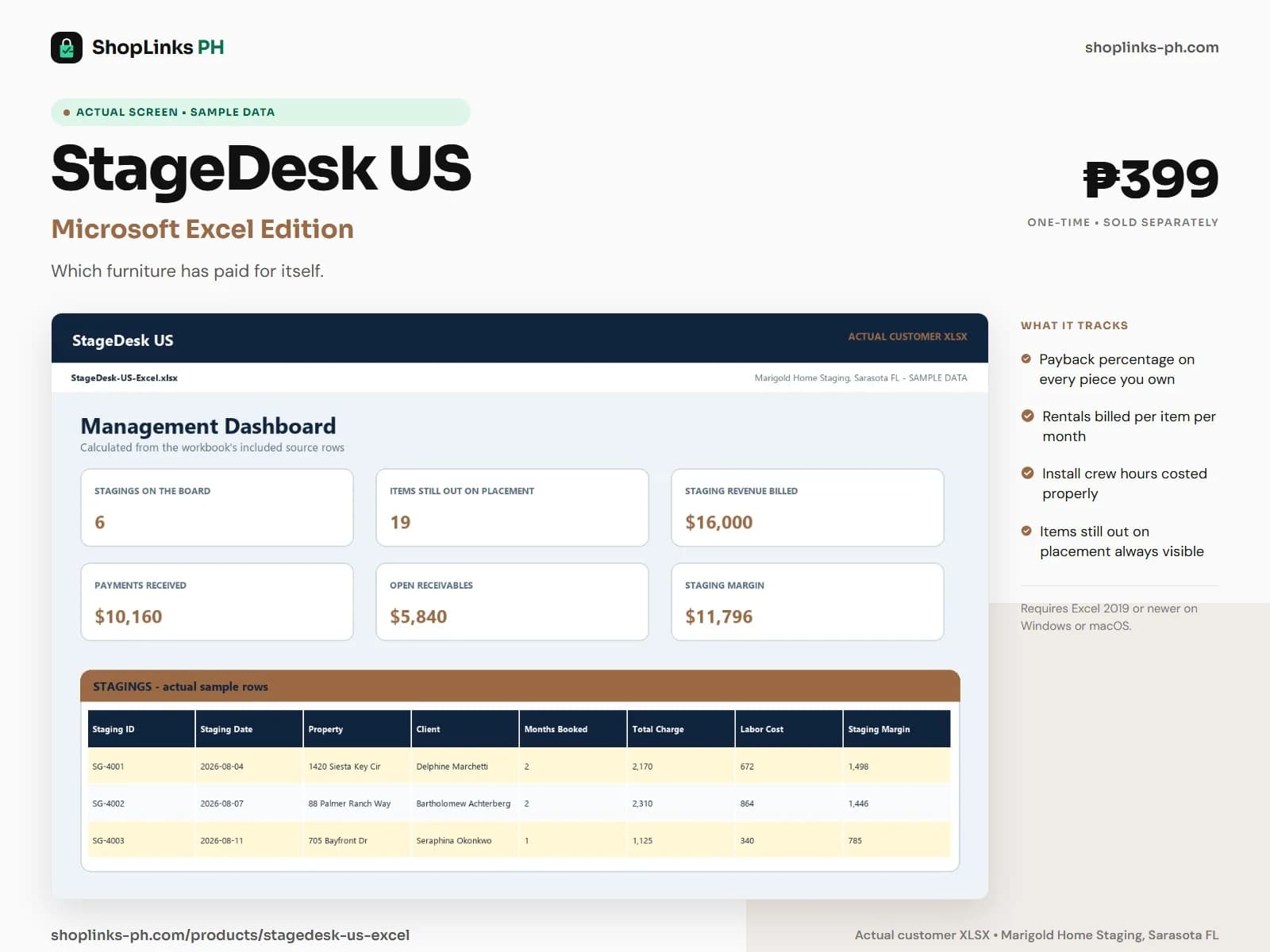
A staging business is a furniture rental business that happens to have good taste. Capital goes out in large lumps to buy a sectional, a dining table and a bed, and comes back in small monthly amounts across dozens of listings. Most stagers can describe their inventory from memory and could not say which pieces have paid for themselves. StageDesk US answers that in a column.
Every piece has a payback figure
Each item records what it cost to acquire and the monthly rate it rents at, and item performance totals what it has earned across every placement.
The payback check reads Paid for itself, Half way, Early or Never placed, which is a buying decision stated as a fact.
Rentals are billed per item per month
A placement records the item, the room and the months charged, and the rental total for the staging assembles from them.
This is more work than a flat staging fee and it is the only way the inventory ever produces usable information.
The install crew is a real cost
Each staging records the crew hours and the crew's own hourly cost, which is what separates a tidy two-bedroom install from an occupied four-bedroom one.
Occupied staging in particular runs long, and a flat design fee absorbs that quietly.
Knowing what is still out
Placements not yet marked returned stay visible, so a piece sitting in a house that sold six weeks ago is a line rather than a memory.
For a business whose stock is scattered across a county, this is the difference between owning inventory and losing it.
Review exceptions every week
Resolve duplicate IDs, missing links, overdue balances, negative amounts, and open operational items in CHECKS before using the dashboard for decisions.
StageDesk US Microsoft Excel Edition is designed for Microsoft Excel 2019 or newer on Windows or macOS.
No MLS or listing integration, no photography or floor planning, no storage facility or warehouse management system, no furniture purchasing or vendor ordering, and no client-facing design proposals.