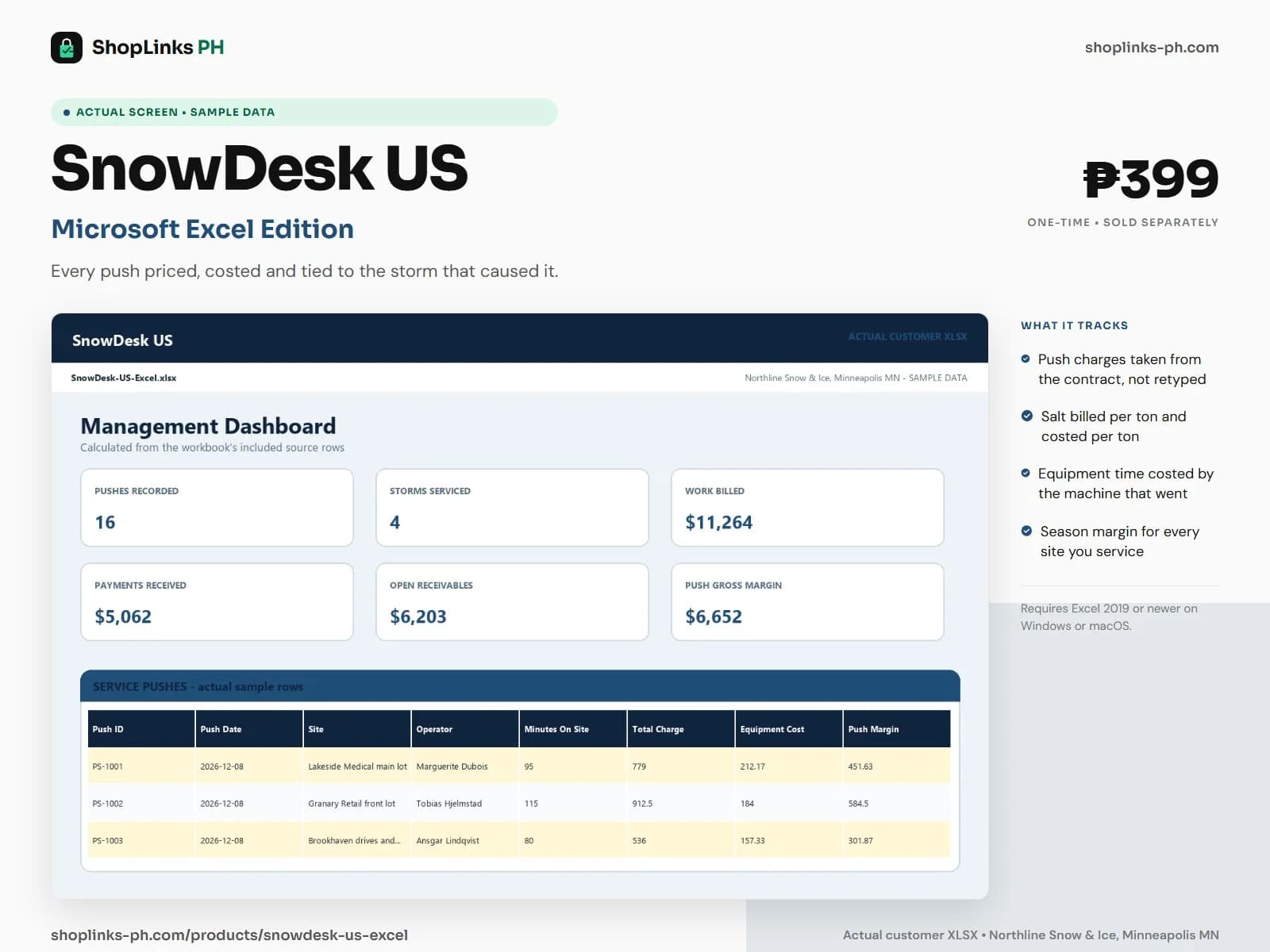
Key takeaways
- Push rates come from the season contract.
- Salt is both billed and costed per ton.
- Equipment cost follows machine minutes.
- Site margin is measured across the season.
Snow work is billed in a hurry and reconciled months later. A storm arrives overnight, trucks run until the lots are clear, and somebody writes the sites on a clipboard. By the time an invoice is raised, nobody remembers whether the retail lot took forty minutes or two hours, or how many tons went down. The season ends profitable or not, and the reason is rarely identified. SnowDesk US records the push while it is still a fact.
The contract sets the price, not the invoice
Each site's push rate and salt rate come from its season contract, so a push is priced the moment it is recorded.
A cancelled push bills nothing without anyone having to remember to zero a line, which is the most common billing error in a fast season.
Salt billed and salt costed
Salt is billed by the ton at the contract rate and costed from the product actually loaded against that push.
Because loading is a movement against the yard stock, the season also answers the harder question: how much salt left the pile compared with how much appeared on invoices.
Machine minutes are the real cost
Equipment carries its own hourly cost, and the push records the minutes on site. A skid steer on a large lot and a truck on a small one are costed differently.
That is what separates a site that is slow because it is big from one that is slow because it was priced wrong.
Margin per site, across the season
Site profitability totals the pushes, the revenue, the equipment cost and the salt cost for each site and labels the result Healthy, Thin or Loss.
A zero-tolerance site that gets salted on every freeze can be compared honestly against a gravel lot plowed four times, which is the comparison renewals actually turn on.
Review exceptions every week
Resolve duplicate IDs, missing links, overdue balances, negative amounts, and open operational items in CHECKS before using the dashboard for decisions.
SnowDesk US Microsoft Excel Edition is designed for Microsoft Excel 2019 or newer on Windows or macOS.
No weather forecasting or automatic storm triggers, no GPS tracking or route dispatch, no slip-and-fall liability documentation or insurance claim handling, no subcontractor payroll, and no municipal or salt-usage environmental reporting.