Key takeaways
- The quote is a rate times an area, held per job.
- Materials leave stock the moment they are drawn.
- Labor sits inside the job cost.
- Progress billings keep the balance honest.
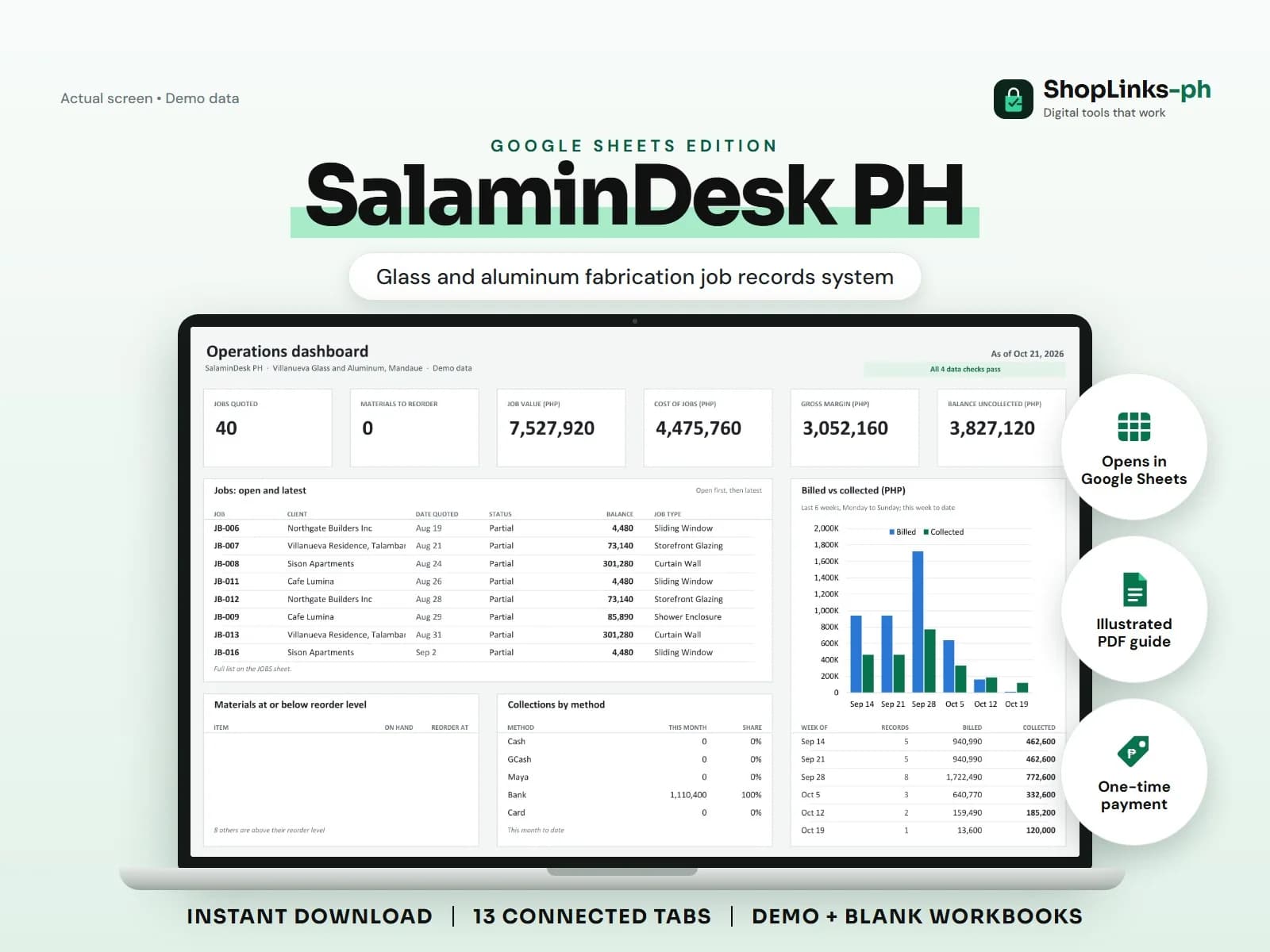
A glass and aluminum shop quotes in square metres and buys in sheets, lengths, sets and tubes. The gap between those two units is where the margin lives and where it usually disappears. SalaminDesk PH keeps materials, jobs, material draws, labor and payments as connected rows, so a shop can see whether the curtain wall it was proud of actually earned more than the shower enclosures.
The quote is a rate and an area
Every job carries an area in square metres and the rate per square metre it was quoted at. The fabrication subtotal follows from those two numbers.
Because the rate sits on the job rather than in a price list, a contractor rate and a household rate can coexist without anyone having to remember which was promised.
Materials leave stock when they are drawn
Glass, frames, rollers, sealant and gasket are drawn to a job as lines. Each line bills at its own price and costs at the material's own unit cost.
The material sheet subtracts what has been drawn, so the reorder list reflects jobs already committed rather than only deliveries already made.
Labor belongs inside the job
Labor cost is entered per job and lands in the cost total beside the materials.
Fabrication shops that treat labor as a monthly overhead cannot tell a profitable job from a busy one, because the jobs that consume the most hours are rarely the ones with the highest material cost.
Progress billing that stays current
Down payments, progress billings and the balance on turnover are all payments against the job, so the balance is always current.
The checks count duplicate job identifiers, jobs naming a client who is not on file, material lines naming a job that does not exist, and any material drawn beyond the stock actually held.
Review exceptions every week
Resolve duplicate IDs, missing links, overdue balances, negative amounts, and open operational items in CHECKS before using the dashboard for decisions.
SalaminDesk PH Google Sheets Edition is designed for use with a Google account and current desktop Google Sheets.
No structural or wind-load engineering calculations, no CAD or cutting optimisation, no supplier purchase orders or payables, no installation crew scheduling calendar, and no warranty or after-sales service tickets.