Key takeaways
- Stop cost combines real minutes and real chemical.
- Chemistry is graded against working ranges.
- Approved repairs are tied to an invoice.
- Cost per stop is measured per technician.
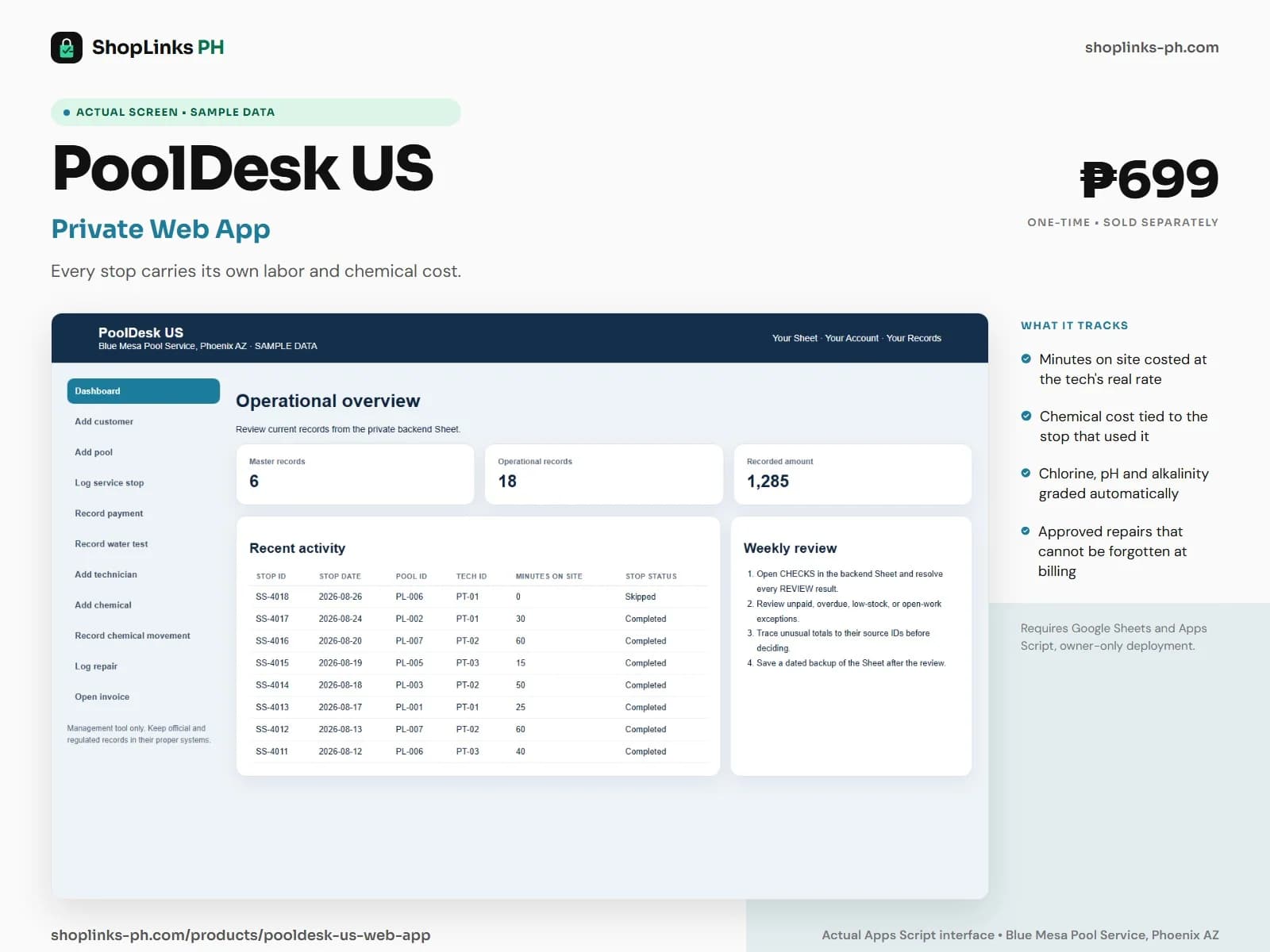
A pool route is priced as a flat monthly rate and delivered as fifty separate visits that cost wildly different amounts. One pool takes twenty minutes and a gallon of chlorine. Another takes forty-five, needs five pounds of shock after a dust storm, and pays the same rate. Nothing on a route sheet records the difference, so the account that is losing money looks exactly like the one that is not. PoolDesk US costs each stop the day it happens.
Minutes and chemical, per stop
Each stop records the minutes actually on site, and the technician's own hourly cost turns that into a labor figure. Chemical is drawn against the stop that used it.
Stop cost is the sum of the two, so the pool that quietly consumes twice the route average is visible without anyone timing a route by hand.
Chemistry graded, not just recorded
Free chlorine, pH and total alkalinity are each compared against their working range and labelled Low, OK or High.
Balance status reads In balance only when all three pass, which turns a column of numbers into a count of pools that need attention this week.
Repairs that survive until billing
A repair records its part cost, its labor charge and whether the customer approved it, and reads Awaiting approval, Scheduled or Completed on its own.
Tagging the repair to an invoice is what gets it billed, so an approved job cannot quietly disappear between the equipment pad and the end of the month.
Cost per stop, per technician
The route summary totals stops, minutes, labor and chemical per technician and divides into a cost per stop.
A plain Efficient, Normal or High label makes route balancing a decision about figures rather than about who complains loudest about their Thursday.
Review exceptions every week
Resolve duplicate IDs, missing links, overdue balances, negative amounts, and open operational items in CHECKS before using the dashboard for decisions.
PoolDesk US Private Google Sheets Web App is designed for use with a Google account, Google Sheets, and Apps Script, using owner-only deployment by default.
No health department inspection filing or public pool compliance reporting, no automated chemical dosing or controller integration, no route optimization or GPS, no customer portal, and no equipment warranty claims.