Key takeaways
- Decide whether a live meeting is needed.
- Make tradeoffs visible before choosing.
- Preserve the decision and its limits.
- Close completed work and escalate blockers.
Start with the next decision
Prepare focused meetings and record decisions, owners and next actions. For small teams that need clearer decisions and follow-through, the useful starting point is a concrete task with an owner and a finished result. A document helps only when it makes the next action easier to understand. Start with one real case and keep the amount of paperwork proportionate to the work.
Use a small practice case
Fictional team Isla Studio has a 25-minute meeting to choose a delivery date for a client proof. Design and review capacity are limited this week. Before using real records, walk through a fictional case like this. It makes missing inputs easier to notice without exposing private customer or business details. The sample quantities, dates and amounts illustrate the process; they are not recommendations for your own operation.
Meeting necessity check
Decide whether a live meeting is needed. Write the decision before inviting anyone. Use an update note when no live discussion is necessary.
For example: Need a shared date after design and review owners compare capacity. A short meeting is useful because their commitments depend on each other. Recurring time on the calendar is not a reason by itself to hold a meeting.
Decision options card
Make tradeoffs visible before choosing. Compare options against the same constraint. Identify facts that must be confirmed before a final choice.
For example: A: proof Wednesday with one review cycle. B: proof Friday with two cycles. Client needs a decision by Monday afternoon. Record an assumption as an assumption until someone verifies it.
Decision register
Preserve the decision and its limits. State what has actually been approved. Include a review trigger when the decision depends on a condition.
For example: D-01: aim for Wednesday proof, subject to client acceptance of one review cycle. Revisit if client requires two cycles. A conditional decision should not be reported as an unconditional commitment.
Weekly follow-through review
Close completed work and escalate blockers. Check completion evidence before marking an action done. Agree a new plan when the original date is no longer realistic.
For example: Client accepted one cycle. Alex closes A-01 with the reply reference; design begins under D-01. Changing a due date should include the reason and the affected commitment.
Test the exception before sharing the record
Try the same task with one missing input: an unanswered question, a changed quantity, an absent owner or an unconfirmed date. Keep the affected decision visibly open, assign a person to confirm the fact and set a next update. A blank response should never silently turn into an approval. Write N/A with a reason when a field does not apply, and preserve the evidence needed to understand your decision later.
Keep one current working copy
After using the record, note the step that caused confusion and revise that part. Add a revision date so the next person can identify the current copy. Archive the completed record according to your business needs, and share only the information the recipient needs. Keep examples clearly labeled and check names, dates, amounts, links and permissions before sending a customer-facing message.
A ready-made starting point
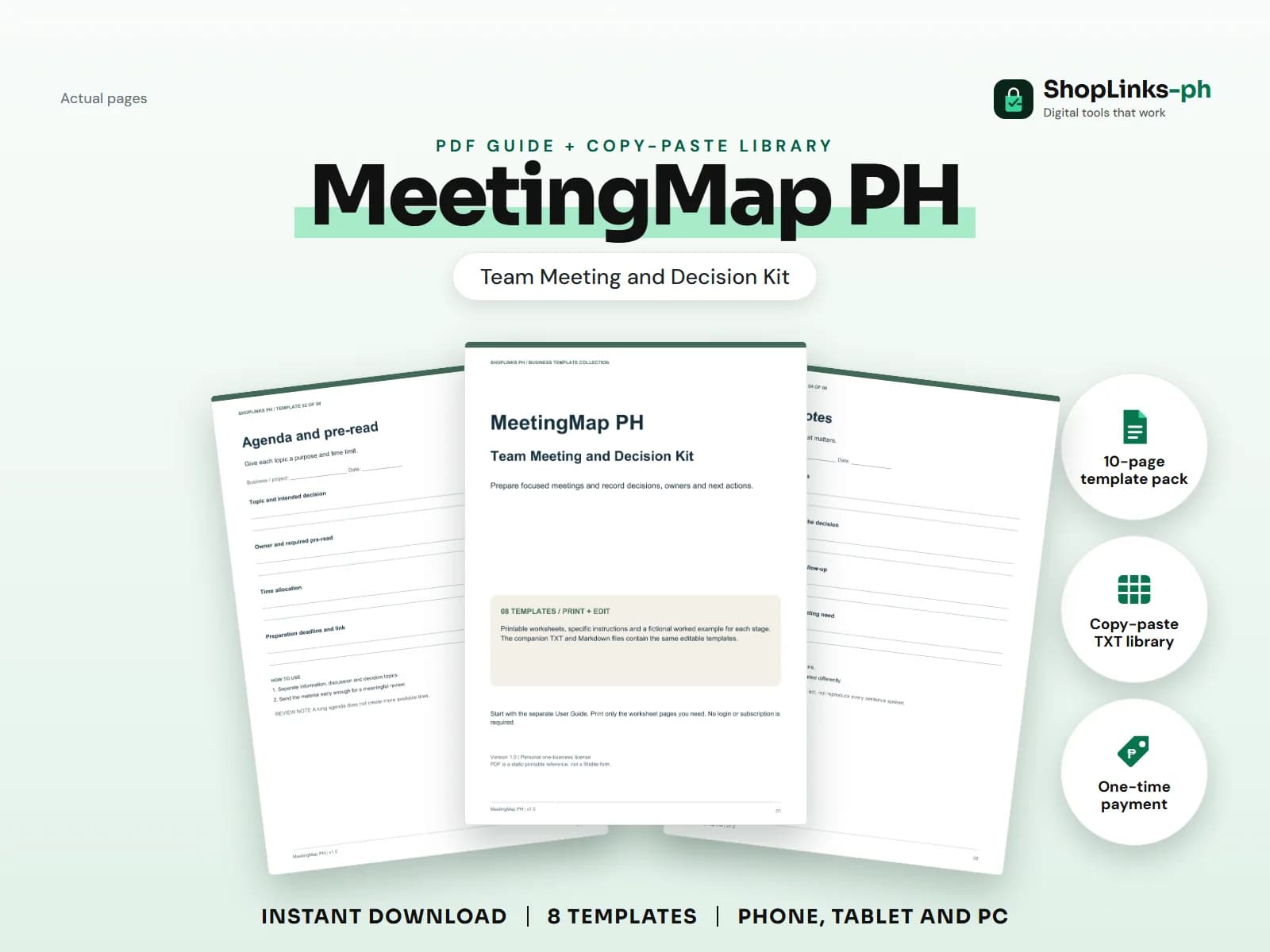
MeetingMap PH includes eight practical templates, a printable PDF, editable TXT and Markdown versions, fictional worked examples and an illustrated user guide. Manual meeting templates only; no calendar integration, recording, transcription, task automation or performance monitoring. You can print the relevant page or copy the text into your preferred editor, then adapt it to the actual task.