Key takeaways
- Agree on what the customer is buying before preparing launch copy.
- Work backward from an agreed launch date.
- Make the release decision with visible evidence.
- Decide what to repeat or change after the launch.
Start with the next decision
Plan one launch from offer definition through the first-week review. For small shops introducing a new product or collection, the useful starting point is a concrete task with an owner and a finished result. A document helps only when it makes the next action easier to understand. Start with one real case and keep the amount of paperwork proportionate to the work.
Use a small practice case
Fictional shop Isla Paper plans a 30-set desk stationery launch. The sample launch date is 21 September 2026; prices, quantities, and dates are illustrative. Before using real records, walk through a fictional case like this. It makes missing inputs easier to notice without exposing private customer or business details. The sample quantities, dates and amounts illustrate the process; they are not recommendations for your own operation.
Offer snapshot
Agree on what the customer is buying before preparing launch copy. Describe one buyer situation and one specific use. Check that every advertised inclusion is actually ready.
For example: Isla Paper: a PHP 249 desk set containing one pad, two cards and one bookmark. Delivery is quoted separately; 30 sets are prepared. Avoid claims such as best or guaranteed unless you can substantiate them.
Launch countdown
Work backward from an agreed launch date. List readiness, photography, listing, dispatch and announcement milestones. Move the launch date if a critical dependency cannot be completed.
For example: 18 Sep: finish inventory count before confirming availability in the 21 Sep announcement. Owner: shop lead. A scheduled post does not prove the product is ready to sell.
Readiness decision
Make the release decision with visible evidence. Walk through one sample order using dummy details. Resolve any mismatch between the listing and the actual package.
For example: Only 28 complete sets pass inspection. Decision: reduce advertised quantity from 30 to 28 before launch. Leave the decision on hold when a critical check has no evidence.
First-week review
Decide what to repeat or change after the launch. Compare the actual questions and issues with the question map. Choose one change you can verify in the next launch.
For example: Four inquiries ask about bookmark size. Action: move the ruler photo to the second product image before the next release. A small sample is a learning signal, not proof of market-wide demand.
Test the exception before sharing the record
Try the same task with one missing input: an unanswered question, a changed quantity, an absent owner or an unconfirmed date. Keep the affected decision visibly open, assign a person to confirm the fact and set a next update. A blank response should never silently turn into an approval. Write N/A with a reason when a field does not apply, and preserve the evidence needed to understand your decision later.
Keep one current working copy
After using the record, note the step that caused confusion and revise that part. Add a revision date so the next person can identify the current copy. Archive the completed record according to your business needs, and share only the information the recipient needs. Keep examples clearly labeled and check names, dates, amounts, links and permissions before sending a customer-facing message.
A ready-made starting point
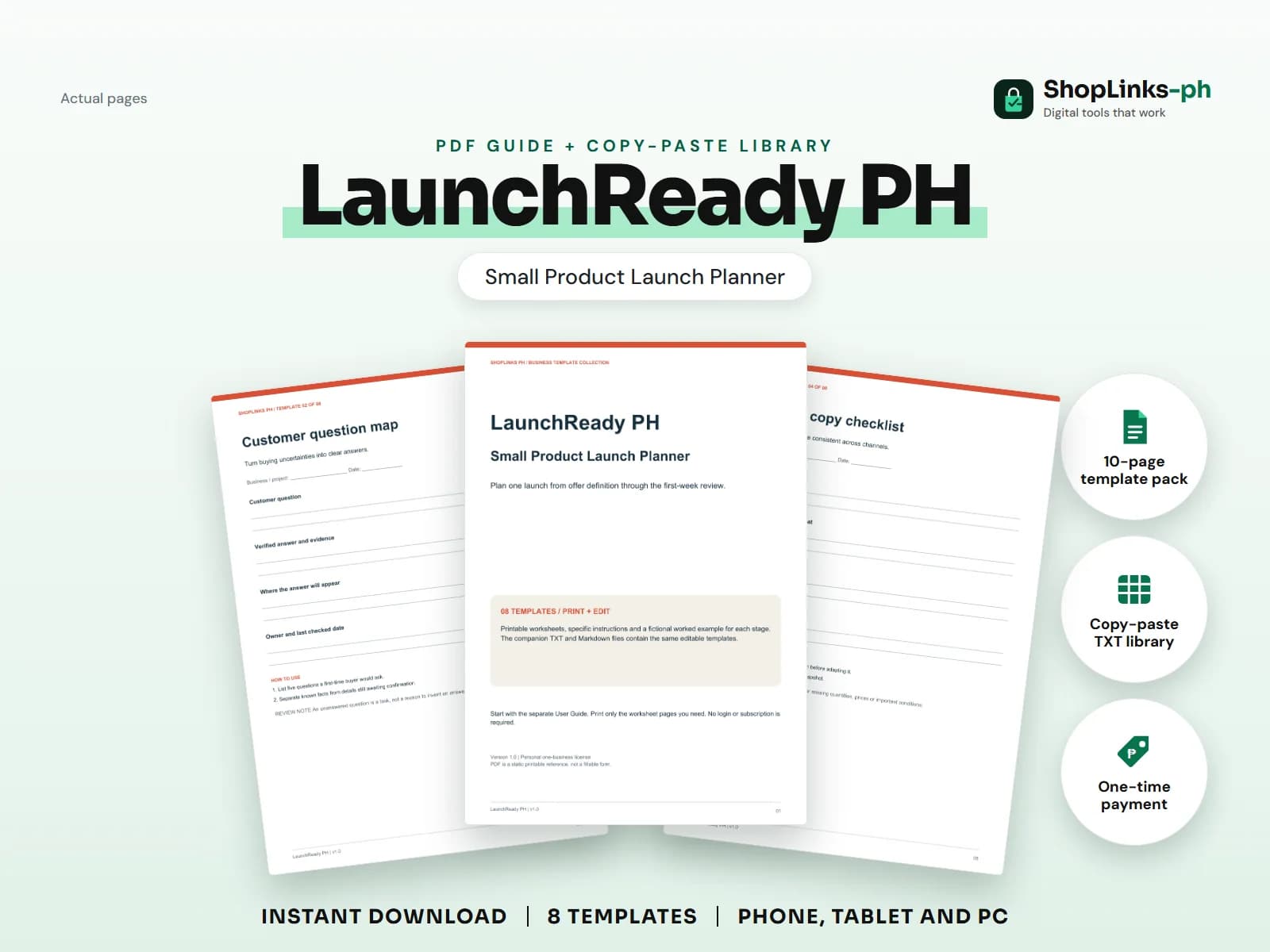
LaunchReady PH includes eight practical templates, a printable PDF, editable TXT and Markdown versions, fictional worked examples and an illustrated user guide. Planning templates only; no advertising service, store integration, cost calculator, or sales forecast. You can print the relevant page or copy the text into your preferred editor, then adapt it to the actual task.