Key takeaways
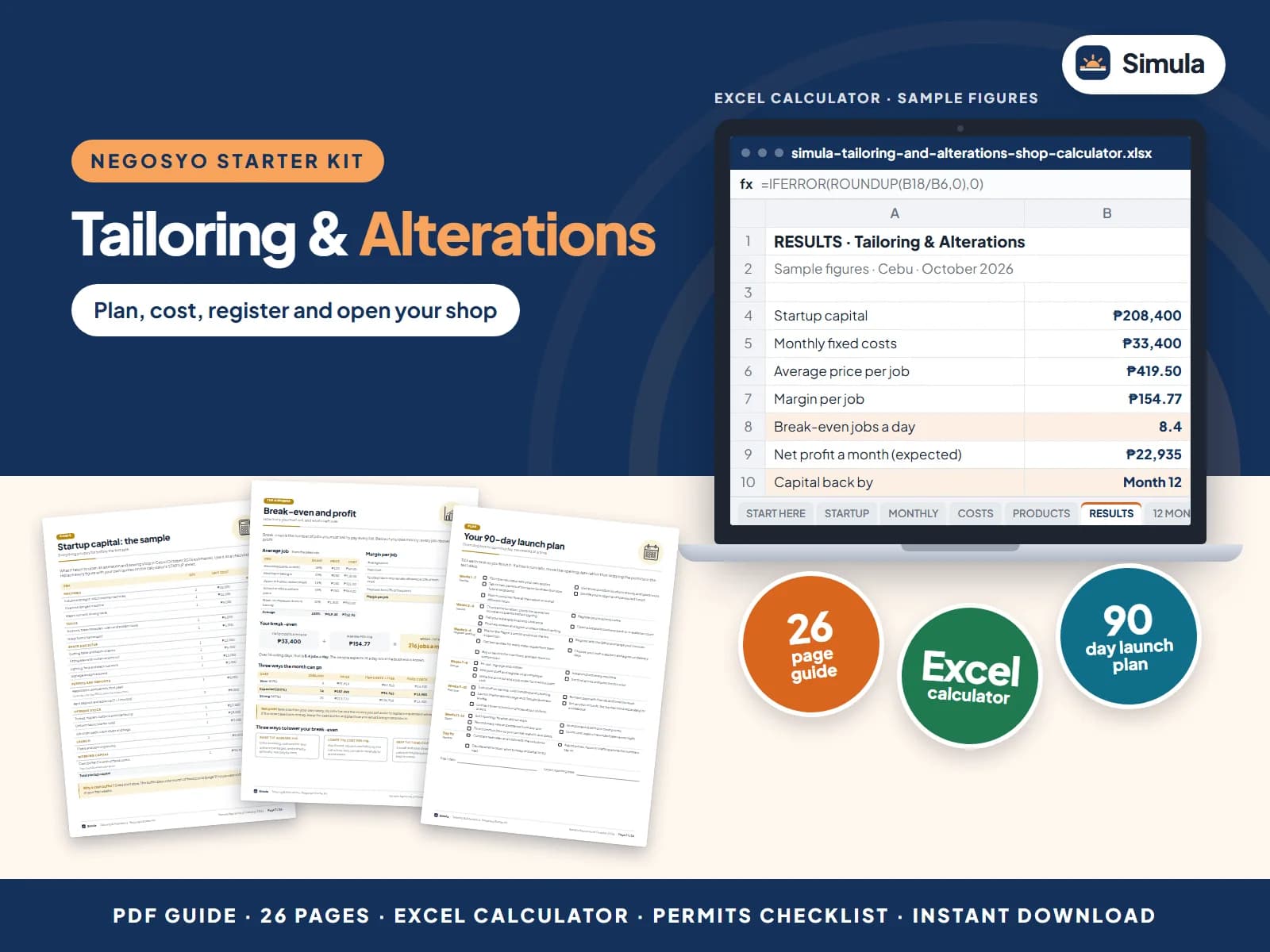
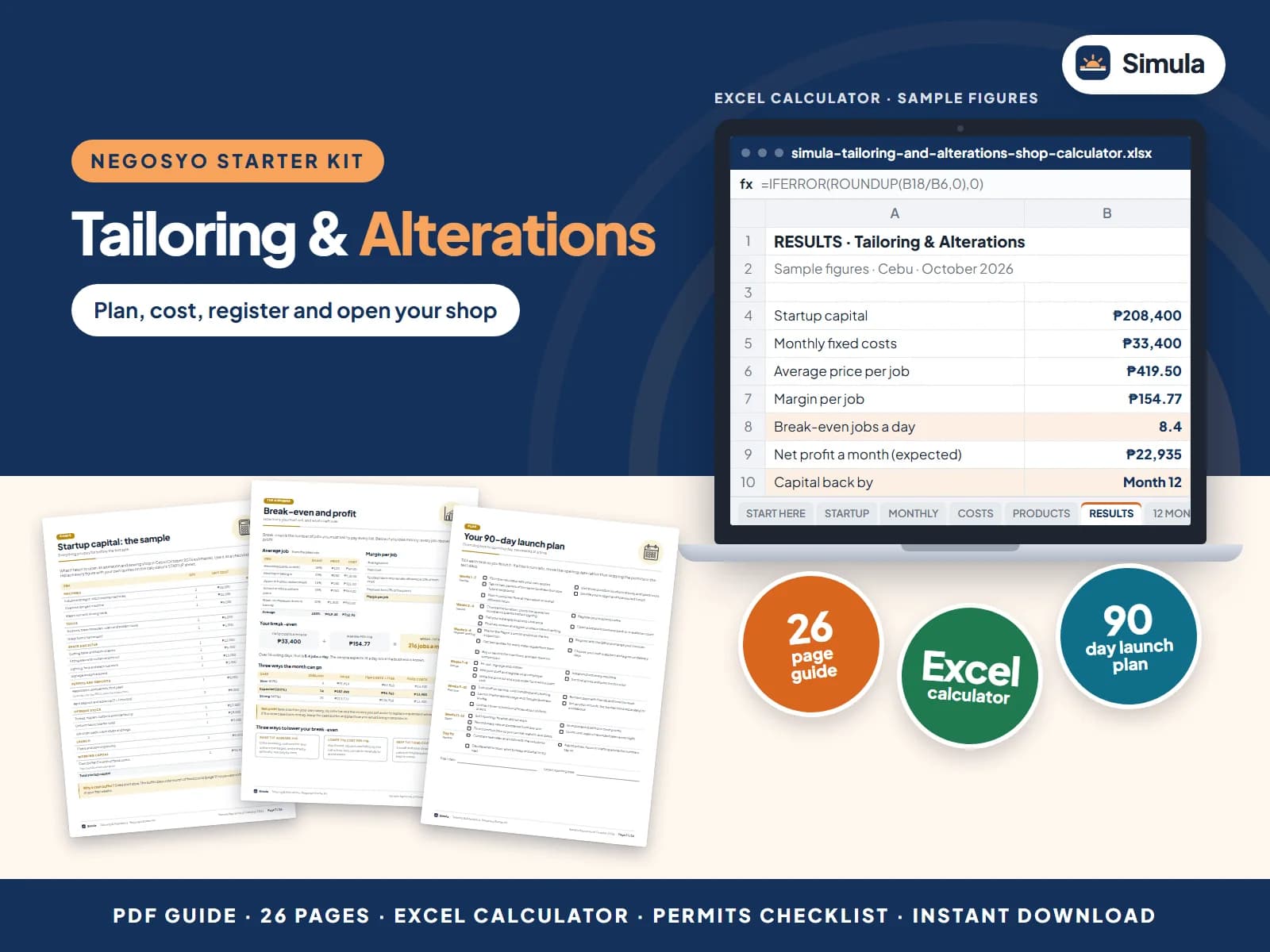
- Sample startup capital: ₱208,400 (October 2026, Cebu).
- Break-even: 8.4 jobs a day.
- Register with DTI, the barangay, the city (Mayor's permit) and BIR; also market stall lease or award and mall tenant requirements.
A tailoring and alterations shop hems, resizes and repairs clothes, and sews uniforms and made-to-measure pieces. Most start with two or three sewing machines in a small stall or street-front shop, with sewers paid per piece. The money is made on a steady flow of quick alterations, uniform orders in school and office season, and finishing every job on the promised date.
This guide walks through what it takes to start a tailoring and alterations shop in the Philippines: the capital, the monthly costs, the permits and the first 90 days. The peso figures are sample estimates for an alteration and sewing shop in Cebu as of October 2026; get your own quotes before you decide.
How much capital you need
The sample comes to about ₱208,400 including one month of fixed costs kept as a cash buffer. It splits into machines (₱67,000), tools (₱11,000), space and setup (₱33,000), permits and deposits (₱32,000), opening stock (₱29,000), launch (₱3,000) and working capital (₱33,400). Other ways to start: home-based alterations at ₱40,000–₱80,000 and uniform and dressmaking shop at ₱500,000–₱900,000.
Monthly costs and break-even
Fixed costs in the sample are ₱33,400 a month; the biggest are counter and finishing helper (₱15,600), rent (₱8,000) and electricity (₱2,500). Each job sold earns about ₱155 after its own costs, so the break-even is 8.4 jobs a day, and the startup capital comes back by month 12 if sales start slow and build up.
Permits and registration
Register the business name with DTI (or SEC or CDA), then get the barangay business clearance, the Mayor's permit through the city or municipal BPLO, and BIR registration; register with SSS, PhilHealth and Pag-IBIG once you hire. A tailoring and alterations shop also needs: market stall lease or award and mall tenant requirements. Requirements and fees differ by city, so ask each office for its checklist first. DTI Negosyo Centers help for free.
Where to set up
- Inside or beside a public market
- Near a mall or store selling ready-to-wear clothes
- Near schools, for uniforms
- Near offices and government buildings
Mistakes to avoid
- Late jobs and broken promises. A due list checked every morning, realistic due dates, and a warning to customers before a job runs late.
- Wrong size or spoiled fabric. Measure twice, record sizes in the customer's file, and fit before the final stitch.
- Unclaimed items piling up. Down payments, reminders, and a posted rule on how long unclaimed items are kept.
- A sewer leaves in the busy season. Fair piece rates paid on time, and a third sewer you can call for rush periods.
Plan it with the starter kit
The Tailoring & Alterations · Negosyo Starter Kit has every worksheet behind this guide in a 26-page PDF, plus an Excel calculator: type in your own quotes and it works out your capital, break-even, profit and payback month. It costs ₱349 and downloads right after payment.