Key takeaways
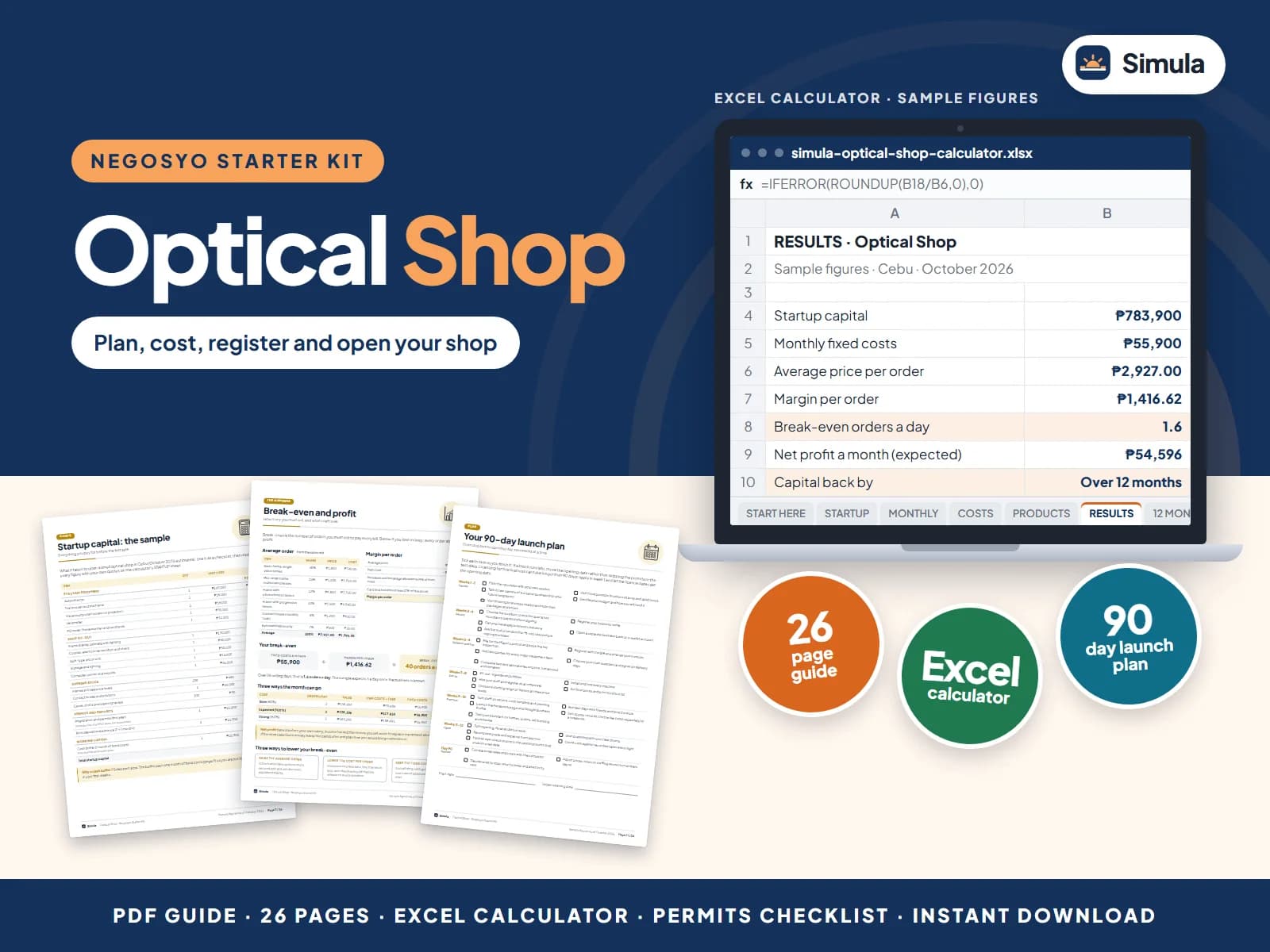
- Sample startup capital: ₱783,900 (October 2026, Cebu).
- Break-even: 1.6 orders a day.
- Register with DTI, the barangay, the city (Mayor's permit) and BIR; also professional tax receipt (PTR), licence to sell contact lenses (ask) and fit-out approval.
For licensed optometrists: an optical shop examines eyes, then sells and fits eyeglasses and contact lenses. Most start as a small shop in a commercial strip or small mall, with lenses made to order by an outside optical laboratory. The money is made on the frames and lens options sold with each order, few remakes, and balances collected on release.
This guide walks through what it takes to start a small optical shop in the Philippines: the capital, the monthly costs, the permits and the first 90 days. The peso figures are sample estimates for a small optical shop in Cebu as of October 2026; get your own quotes before you decide.
How much capital you need
The sample comes to about ₱783,900 including one month of fixed costs kept as a cash buffer. It splits into eye exam equipment (₱262,000), shop fit-out (₱260,000), opening stock (₱119,000), permits and deposits (₱87,000) and working capital (₱55,900). Other ways to start: mall optical counter at ₱1.2 million–₱2 million and optical shop with in-house edging at ₱2 million and up.
Monthly costs and break-even
Fixed costs in the sample are ₱55,900 a month; the biggest are rent (₱25,000), sales assistant (₱15,600) and electricity (₱4,500). Each order sold earns about ₱1,417 after its own costs, so the break-even is 1.6 orders a day, and the startup capital takes about 14 months to come back at full sales.
Permits and registration
Register the business name with DTI (or SEC or CDA), then get the barangay business clearance, the Mayor's permit through the city or municipal BPLO, and BIR registration; register with SSS, PhilHealth and Pag-IBIG once you hire. A small optical shop also needs: professional tax receipt (PTR), licence to sell contact lenses (ask) and fit-out approval. Requirements and fees differ by city, so ask each office for its checklist first. DTI Negosyo Centers help for free.
Where to set up
- Ground floor of a commercial strip with foot traffic
- Near schools, offices and BPOs
- Inside or beside a small mall
- Near clinics and laboratories
Mistakes to avoid
- Lenses come back wrong. Measure carefully, write clear orders, check every job before release, and use a lab with a fair remake policy.
- Unsold frames tie up cash. Buy frames in small lots, track what sells, and agree exchanges with distributors.
- Unpaid balances and unclaimed glasses. A downpayment of at least half, a text when ready, and a written rule on unclaimed orders.
- Late jobs and broken promises. Give realistic dates, track every lab job daily, and call customers before they come in.
Plan it with the starter kit
The Optical Shop · Negosyo Starter Kit has every worksheet behind this guide in a 26-page PDF, plus an Excel calculator: type in your own quotes and it works out your capital, break-even, profit and payback month. It costs ₱499 and downloads right after payment.