Key takeaways
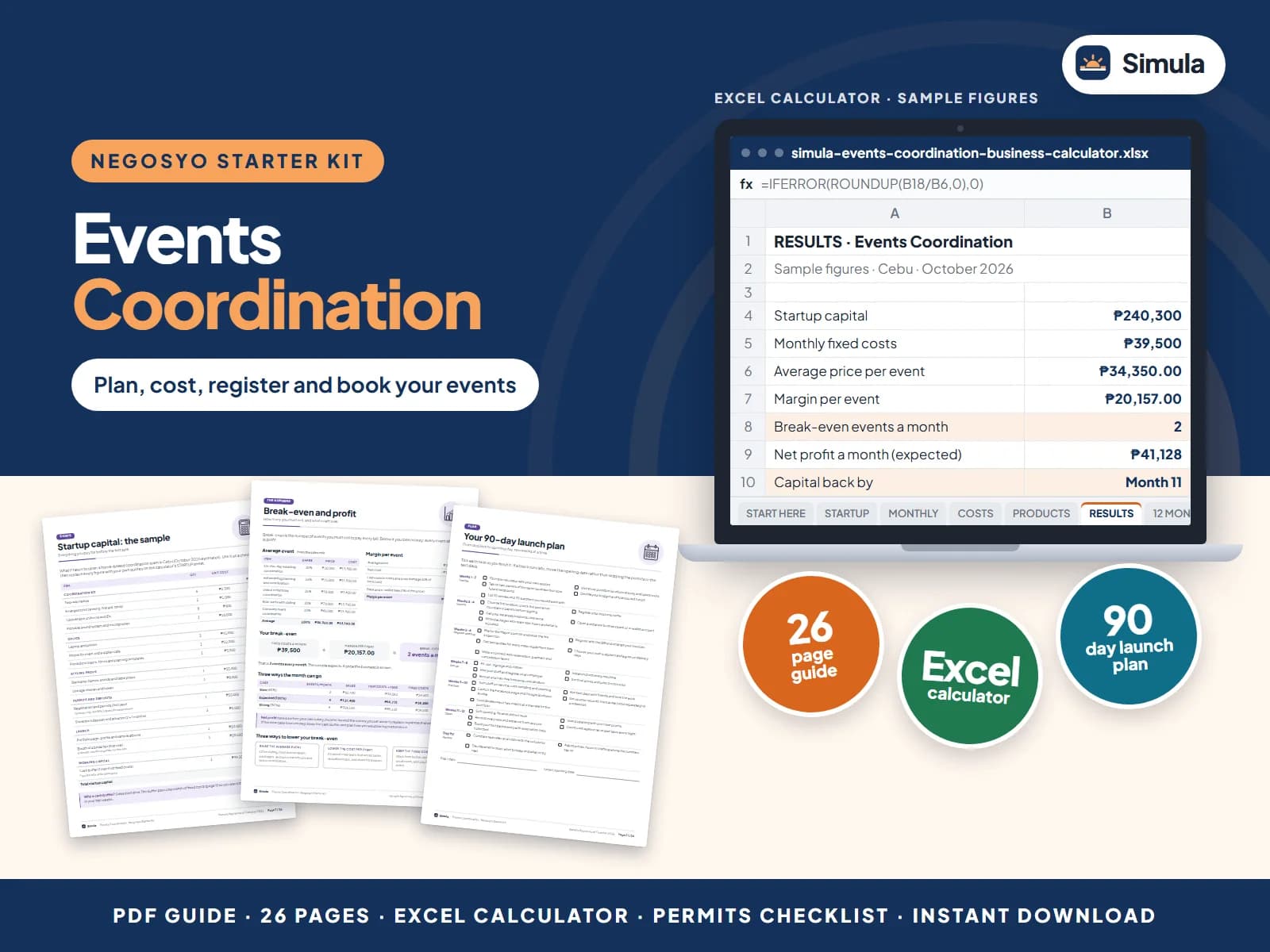
- Sample startup capital: ₱240,300 (October 2026, Cebu).
- Break-even: 2 events a month.
- Register with DTI, the barangay, the city (Mayor's permit) and BIR; also permits for events in public places, fire safety for temporary set-ups and noise and curfew rules.
An events coordination business plans and runs weddings, debuts, birthdays and company events, working with the client's caterer, venue and other suppliers. Most start from home with one assistant and a team of freelance coordinators for each event. The money is made on fees and packages priced with their real team costs, deposits collected early, and events smooth enough to earn referrals.
This guide walks through what it takes to start a small events coordination business in the Philippines: the capital, the monthly costs, the permits and the first 90 days. The peso figures are sample estimates for a home-based coordination team in Cebu as of October 2026; get your own quotes before you decide.
How much capital you need
The sample comes to about ₱240,300 including one month of fixed costs kept as a cash buffer. It splits into coordination kit (₱42,800), office (₱60,000), styling props (₱43,000), permits and deposits (₱25,000), launch (₱30,000) and working capital (₱39,500). Other ways to start: coordination with styling packages at ₱400,000–₱800,000 and full events company at ₱1.5 million and up.
Monthly costs and break-even
Fixed costs in the sample are ₱39,500 a month; the biggest are assistant coordinator (₱16,900), marketing (₱6,000) and storeroom rent (₱5,000). Each event sold earns about ₱20,157 after its own costs, so the break-even is 2 events a month, and the startup capital comes back by month 11 if sales start slow and build up.
Permits and registration
Register the business name with DTI (or SEC or CDA), then get the barangay business clearance, the Mayor's permit through the city or municipal BPLO, and BIR registration; register with SSS, PhilHealth and Pag-IBIG once you hire. A small events coordination business also needs: permits for events in public places, fire safety for temporary set-ups and noise and curfew rules. Requirements and fees differ by city, so ask each office for its checklist first. DTI Negosyo Centers help for free.
Where to set up
- Near the hotels, resorts and event venues you will work with
- In a city with many caterers and suppliers to choose from
- A storeroom close to a main road for loading
- A home office is enough at first; clients meet you at venues
Mistakes to avoid
- A supplier fails on the day. Written confirmations, a call the day before, and a backup supplier list for each service.
- Clients who pay late. A payment schedule that ends before the event date, written into the contract.
- Last-minute changes eat the margin. A cut-off date for changes, and a price for every extra.
- Bad weather at outdoor events. A rain plan agreed with the client and the venue for every outdoor event.
Plan it with the starter kit
The Events Coordination · Negosyo Starter Kit has every worksheet behind this guide in a 26-page PDF, plus an Excel calculator: type in your own quotes and it works out your capital, break-even, profit and payback month. It costs ₱349 and downloads right after payment.