Key takeaways
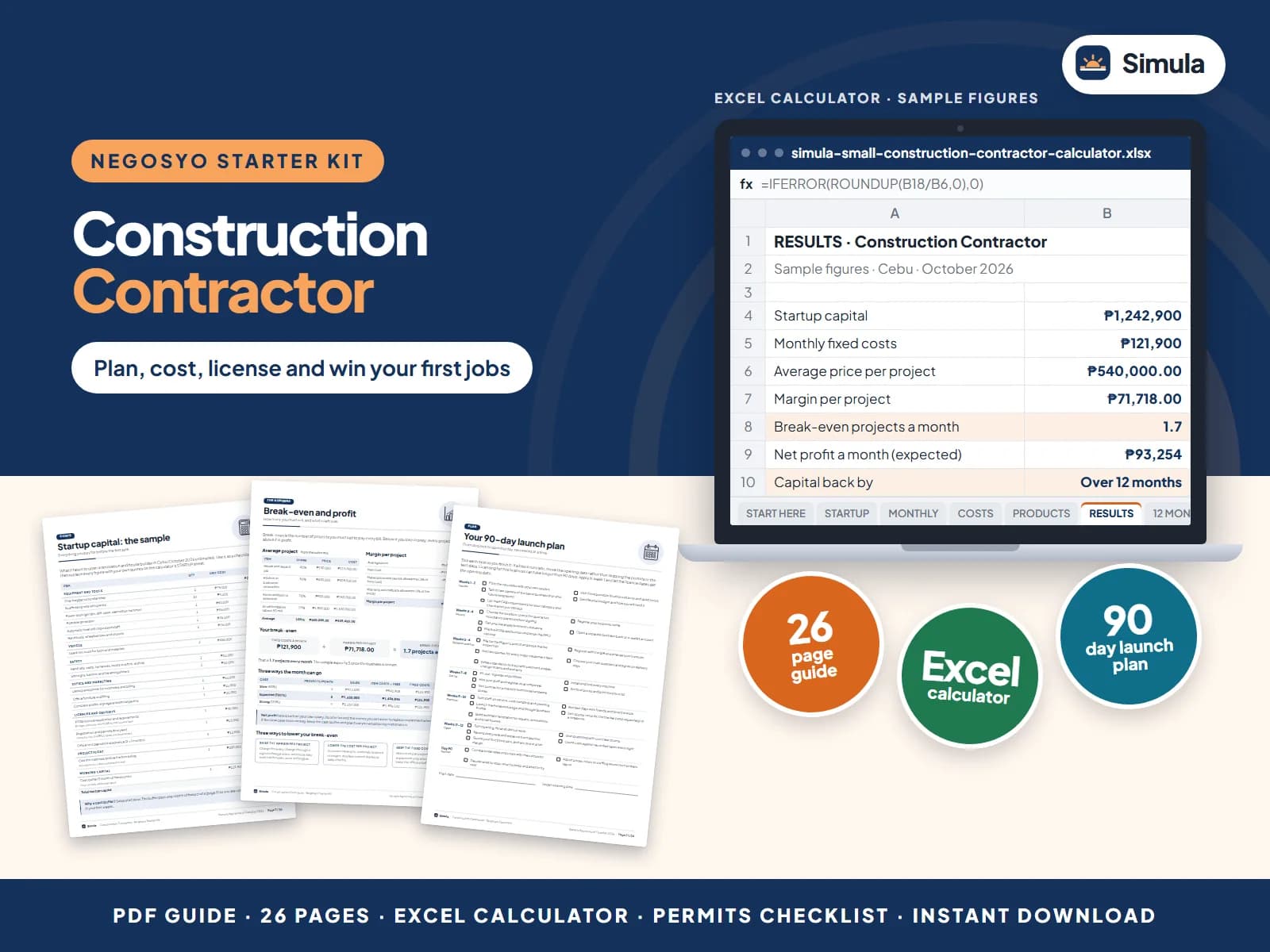
- Sample startup capital: ₱1,242,900 (October 2026, Cebu).
- Break-even: 1.7 projects a month.
- Register with DTI, the barangay, the city (Mayor's permit) and BIR; also PCAB contractor's licence, AMO seminar and technical staff for PCAB, building permit for each project and construction safety and health program.
A small construction contractor builds and renovates houses, extensions and small commercial spaces for private clients. This kit is for contractors who hold, or are applying for, a PCAB licence; most start with renovation jobs and a small crew, then take on whole houses. The money is made on accurate estimates, signed change orders, billing on time and keeping material waste down.
This guide walks through what it takes to start a small construction contracting business in the Philippines: the capital, the monthly costs, the permits and the first 90 days. The peso figures are sample estimates for a renovation and house builder in Cebu as of October 2026; get your own quotes before you decide.
How much capital you need
The sample comes to about ₱1,242,900 including one month of fixed costs kept as a cash buffer. It splits into equipment and tools (₱265,000), vehicle (₱450,000), safety (₱35,000), office and marketing (₱80,000), licences and deposits (₱91,000), project float (₱200,000) and working capital (₱121,900). Other ways to start: licensed trade or specialty contractor at ₱500,000–₱1 million and design-and-build firm at ₱3 million–₱6 million.
Monthly costs and break-even
Fixed costs in the sample are ₱121,900 a month; the biggest are project engineer (₱28,000), foreman (₱22,100) and office and site assistant (₱15,600). Each project sold earns about ₱71,718 after its own costs, so the break-even is 1.7 projects a month, and the startup capital takes about 13 months to come back at full sales.
Permits and registration
Register the business name with DTI (or SEC or CDA), then get the barangay business clearance, the Mayor's permit through the city or municipal BPLO, and BIR registration; register with SSS, PhilHealth and Pag-IBIG once you hire. A small construction contracting business also needs: PCAB contractor's licence, AMO seminar and technical staff for PCAB, building permit for each project and construction safety and health program. Requirements and fees differ by city, so ask each office for its checklist first. DTI Negosyo Centers help for free.
Where to set up
- Within an hour of the areas where you will build
- Near hardware and construction supply stores
- In a growing town with many new house lots
- Close to a yard where tools and scaffolding can be stored
Mistakes to avoid
- Underpriced estimates. Price from a bill of quantities, include a contingency, and compare every finished job with its estimate.
- Clients who pay late or stop paying. A down payment, staged billings in the contract, and work paused when a billing is far overdue.
- Unpaid extra work. No extra work without a signed change order showing the price and the added days.
- Site accidents. Safety gear, daily safety talks, sound scaffolding, and insurance for workers and the site.
Plan it with the starter kit
The Construction Contractor · Negosyo Starter Kit has every worksheet behind this guide in a 26-page PDF, plus an Excel calculator: type in your own quotes and it works out your capital, break-even, profit and payback month. It costs ₱499 and downloads right after payment.