Key takeaways
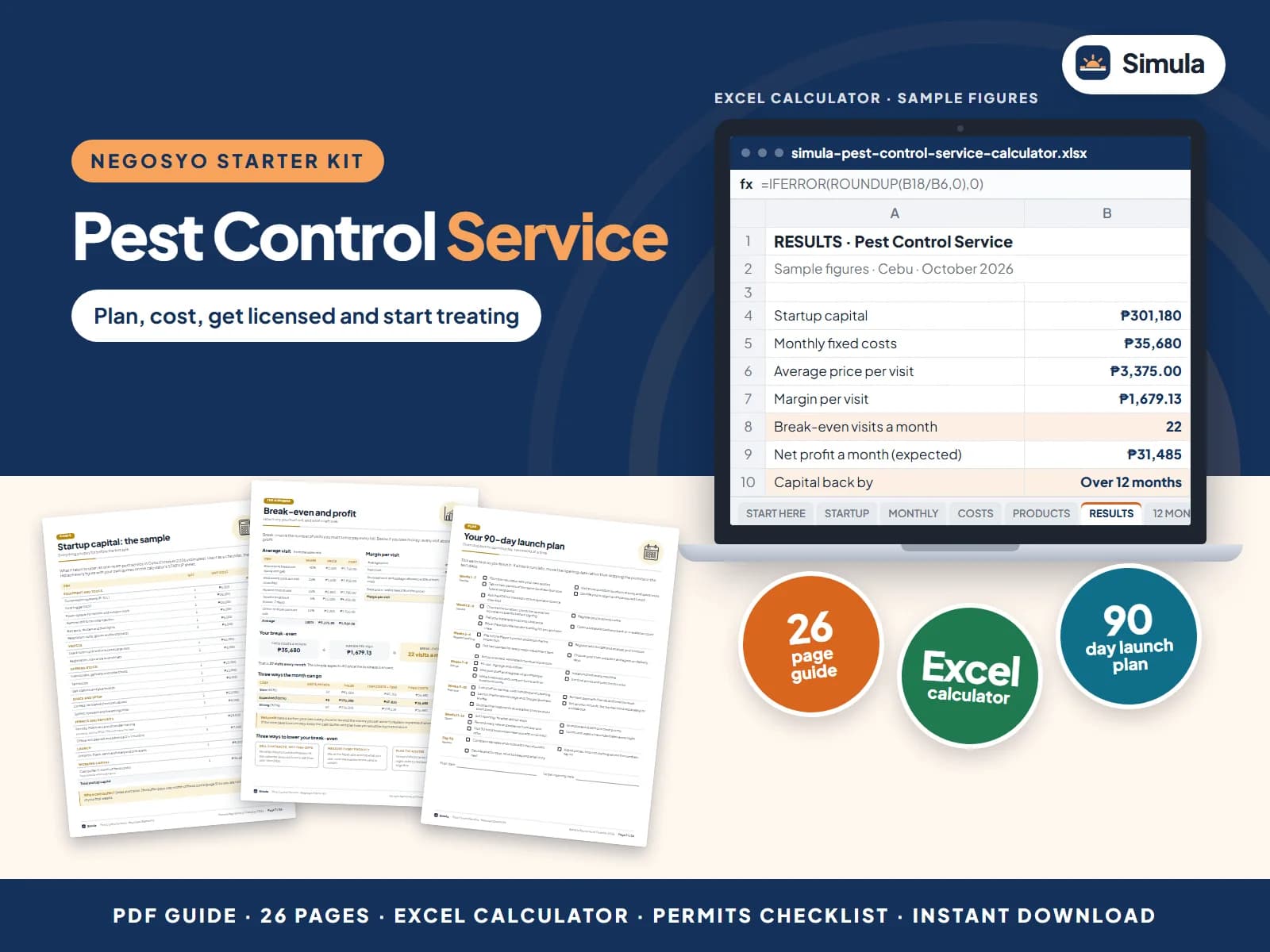
- Sample startup capital: ₱301,180 (October 2026, Cebu).
- Break-even: 22 visits a month.
- Register with DTI, the barangay, the city (Mayor's permit) and BIR; also FDA licence to operate as a pest control operator, training for every pesticide handler and FPA licence for farm and fumigation work.
A pest control service treats homes, restaurants, offices and stores for cockroaches, ants, rats, termites and mosquitoes. This kit is for operators who hold, or will get, the FDA licence to operate, starting as one trained team with sprayers, a fogger and a motorcycle. The money is in monthly contracts that repeat, measured use of chemicals, and results that keep clients from calling someone else.
This guide walks through what it takes to start a pest control service in the Philippines: the capital, the monthly costs, the permits and the first 90 days. The peso figures are sample estimates for an one-team pest service in Cebu as of October 2026; get your own quotes before you decide.
How much capital you need
The sample comes to about ₱301,180 including one month of fixed costs kept as a cash buffer. It splits into equipment and tools (₱80,500), vehicle (₱66,000), opening stock (₱45,000), space and setup (₱20,000), permits and deposits (₱46,000), launch (₱8,000) and working capital (₱35,680). Other ways to start: two-team operator with contracts at ₱700,000–₱1.2 million and termite and fumigation specialist at ₱1.5 million and up.
Monthly costs and break-even
Fixed costs in the sample are ₱35,680 a month; the biggest are helper wage (₱15,600), office and chemical storeroom rent (₱7,000) and SSS, PhilHealth and Pag-IBIG (₱2,180). Each visit sold earns about ₱1,679 after its own costs, so the break-even is 22 visits a month, and the startup capital takes about 10 months to come back at full sales.
Permits and registration
Register the business name with DTI (or SEC or CDA), then get the barangay business clearance, the Mayor's permit through the city or municipal BPLO, and BIR registration; register with SSS, PhilHealth and Pag-IBIG once you hire. A pest control service also needs: FDA licence to operate as a pest control operator, training for every pesticide handler and FPA licence for farm and fumigation work. Requirements and fees differ by city, so ask each office for its checklist first. DTI Negosyo Centers help for free.
Where to set up
- Near business districts with many restaurants
- Areas with older wooden houses, for termite work
- Near markets, warehouses and food processors
- Within 30–40 minutes of most of your clients
Mistakes to avoid
- Poisoning of people or pets. Follow the label, clear the area first, use baits in locked stations and tell clients when it is safe to return.
- Working without the FDA licence. Get the licence and the training before your first paid job; clients and buildings will ask for them.
- Pests come back and clients leave. Inspect before treating, fix entry points with the client, and do re-treatments quickly.
- Chemicals stolen or spilled. Locked storage, a stock log, and a spill kit in every vehicle.
Plan it with the starter kit
The Pest Control Service · Negosyo Starter Kit has every worksheet behind this guide in a 26-page PDF, plus an Excel calculator: type in your own quotes and it works out your capital, break-even, profit and payback month. It costs ₱349 and downloads right after payment.
