Key takeaways
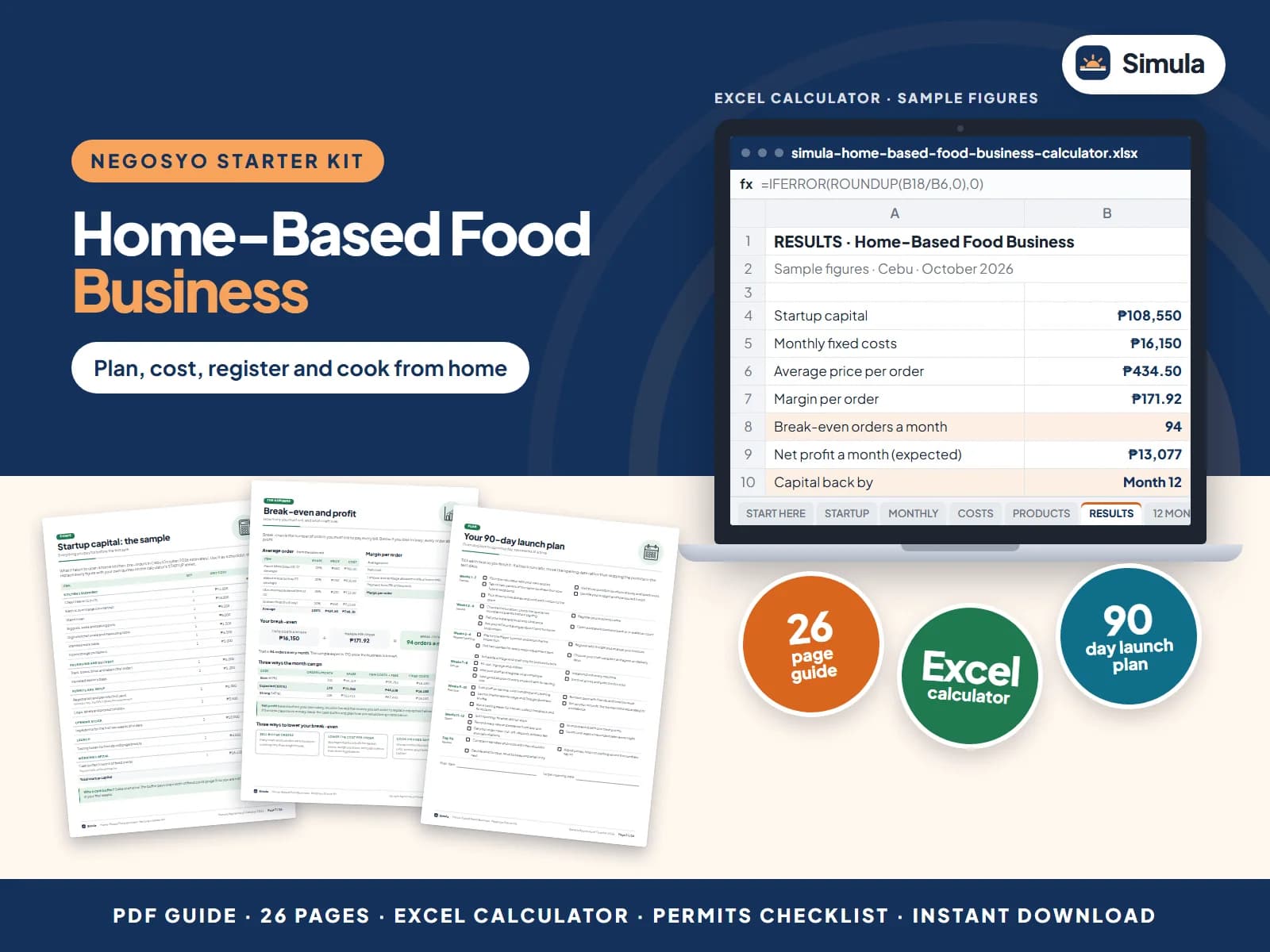
- Sample startup capital: ₱108,550 (October 2026, Cebu).
- Break-even: 94 orders a month.
- Register with DTI, the barangay, the city (Mayor's permit) and BIR; also sanitary permit and health certificate, HOA or barangay approval of a home business and FDA licence to operate (only for packaged food).
A home-based food business cooks or bakes in your own kitchen and sells by pre-order: party trays, baked goods and desserts, picked up or delivered. Most start with a few dishes friends already ask for, sold to neighbors, school parents and online followers. The money is made by costing every recipe properly, cooking only what has been ordered and paid for, and earning repeat buyers.
This guide walks through what it takes to start a home-based food business in the Philippines: the capital, the monthly costs, the permits and the first 90 days. The peso figures are sample estimates for a home kitchen, pre-orders in Cebu as of October 2026; get your own quotes before you decide.
How much capital you need
The sample comes to about ₱108,550 including one month of fixed costs kept as a cash buffer. It splits into kitchen equipment (₱60,500), packaging and delivery (₱8,400), permits and setup (₱9,500), opening stock (₱10,000), launch (₱4,000) and working capital (₱16,150). Other ways to start: packed lunches for offices at ₱80,000–₱150,000 and packaged goods for stores and online at ₱200,000–₱400,000.
Monthly costs and break-even
Fixed costs in the sample are ₱16,150 a month; the biggest are part-time helper (₱7,800), extra electricity (₱2,500) and page boosts and marketing (₱1,500). Each order sold earns about ₱172 after its own costs, so the break-even is 94 orders a month, and the startup capital comes back by month 12 if sales start slow and build up.
Permits and registration
Register the business name with DTI (or SEC or CDA), then get the barangay business clearance, the Mayor's permit through the city or municipal BPLO, and BIR registration; register with SSS, PhilHealth and Pag-IBIG once you hire. A home-based food business also needs: sanitary permit and health certificate, HOA or barangay approval of a home business and FDA licence to operate (only for packaged food). Requirements and fees differ by city, so ask each office for its checklist first. DTI Negosyo Centers help for free.
Where to set up
- A home within 5 km of the subdivisions and offices you deliver to
- A barangay with many families and few home cooks selling the same thing
- Near schools or churches where parents order for events
- A street where delivery riders can stop and pick up easily
Mistakes to avoid
- No-shows on big orders. Take a deposit on every order, and full payment for big trays before you cook.
- Underpricing because costs were guessed. Cost every recipe with real prices, including packaging and LPG, and review it monthly.
- Food safety complaints. Clean surfaces, keep raw and cooked food apart, cool before packing, and label pickup times.
- Burnout from cooking every day. Set fixed cooking days and a weekly order limit you can keep.
Plan it with the starter kit
The Home-Based Food Business · Negosyo Starter Kit has every worksheet behind this guide in a 26-page PDF, plus an Excel calculator: type in your own quotes and it works out your capital, break-even, profit and payback month. It costs ₱349 and downloads right after payment.