Key takeaways
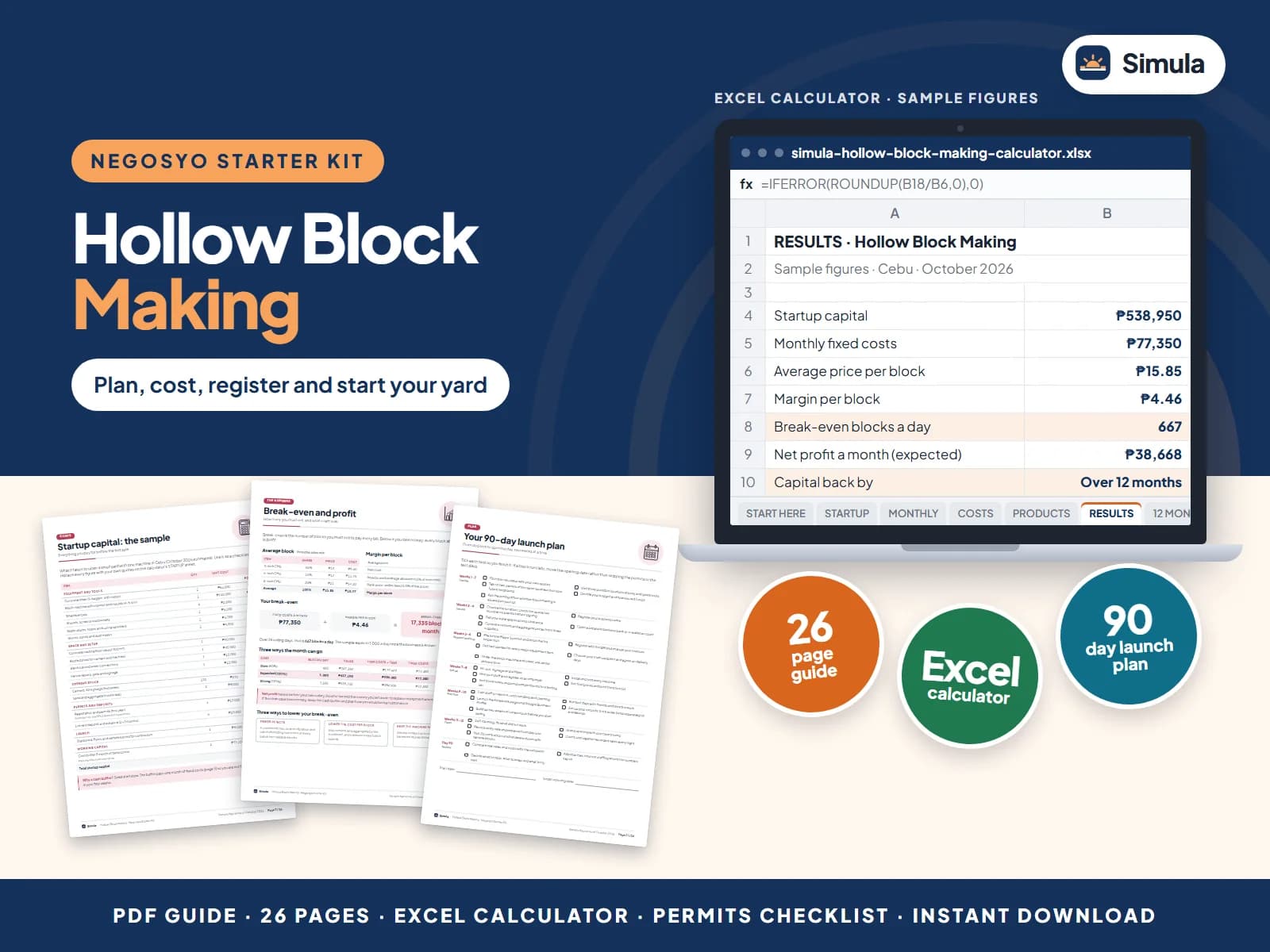
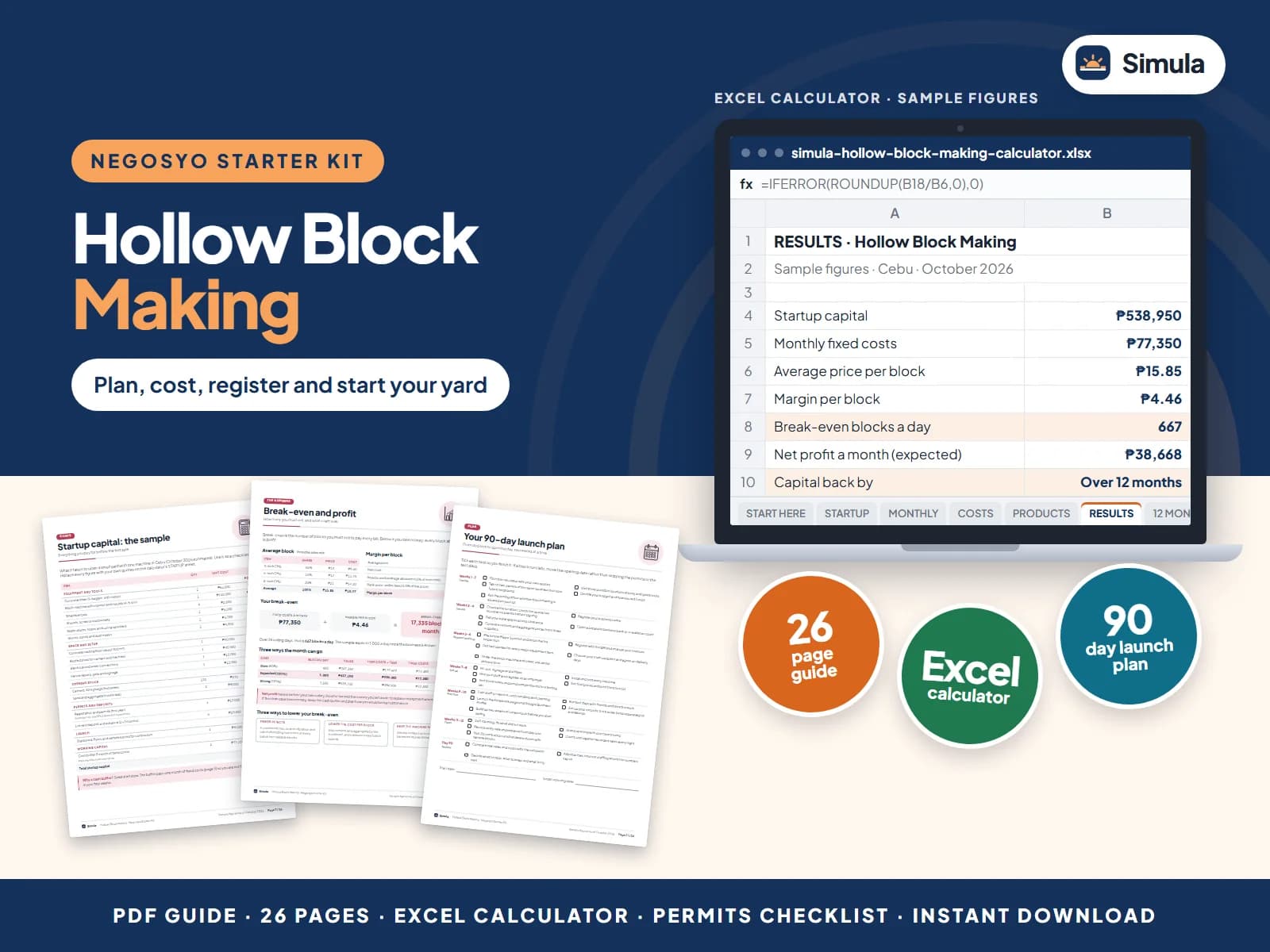
- Sample startup capital: ₱538,950 (October 2026, Cebu).
- Break-even: 667 blocks a day.
- Register with DTI, the barangay, the city (Mayor's permit) and BIR; also zoning or locational clearance for the yard, environmental permits, block strength test and receipts for sand and aggregate.
A hollow block business makes concrete hollow blocks (CHB) from cement, sand and fine aggregate, cures them in a yard and sells them to builders, contractors and hardware stores. Most start on a rented lot with a mixer, one block machine and three workers. The money is in a mix that gives strong blocks at the lowest cement per piece, few rejects, and steady orders that keep the machine running.
This guide walks through what it takes to start a hollow block business in the Philippines: the capital, the monthly costs, the permits and the first 90 days. The peso figures are sample estimates for a small yard with one machine in Cebu as of October 2026; get your own quotes before you decide.
How much capital you need
The sample comes to about ₱538,950 including one month of fixed costs kept as a cash buffer. It splits into equipment and tools (₱201,200), space and setup (₱165,000), opening stock (₱48,400), permits and deposits (₱42,000), launch (₱5,000) and working capital (₱77,350). Other ways to start: backyard maker, made to order at ₱120,000–₱200,000 and semi-automatic plant with a truck at ₱2.5 million and up.
Monthly costs and break-even
Fixed costs in the sample are ₱77,350 a month; the biggest are block makers (₱46,800), lot rent (₱10,000) and SSS, PhilHealth and Pag-IBIG (₱6,550). Each block sold earns about ₱4 after its own costs, so the break-even is 667 blocks a day, and the startup capital takes about 14 months to come back at full sales.
Permits and registration
Register the business name with DTI (or SEC or CDA), then get the barangay business clearance, the Mayor's permit through the city or municipal BPLO, and BIR registration; register with SSS, PhilHealth and Pag-IBIG once you hire. A hollow block business also needs: zoning or locational clearance for the yard, environmental permits, block strength test and receipts for sand and aggregate. Requirements and fees differ by city, so ask each office for its checklist first. DTI Negosyo Centers help for free.
Where to set up
- Near growing subdivisions and construction areas
- On a road a delivery truck can use in all weather
- Close to sand and aggregate sources
- A lot zoned for light industry, or allowed by the city
Mistakes to avoid
- Weak blocks that crack. A fixed mix, proper vibration, at least a week of moist curing, and a strength test before you sell.
- Rain ruins cement and new blocks. Covered cement storage, tarpaulins over new batches and a well-drained yard.
- Cement prices rise. Buy by the truckload when prices are good, and keep quotes valid for a short time.
- Customers do not pay. Cash on delivery for new buyers, and terms only for contractors who pay on time.
Plan it with the starter kit
The Hollow Block Making · Negosyo Starter Kit has every worksheet behind this guide in a 26-page PDF, plus an Excel calculator: type in your own quotes and it works out your capital, break-even, profit and payback month. It costs ₱349 and downloads right after payment.