Key takeaways
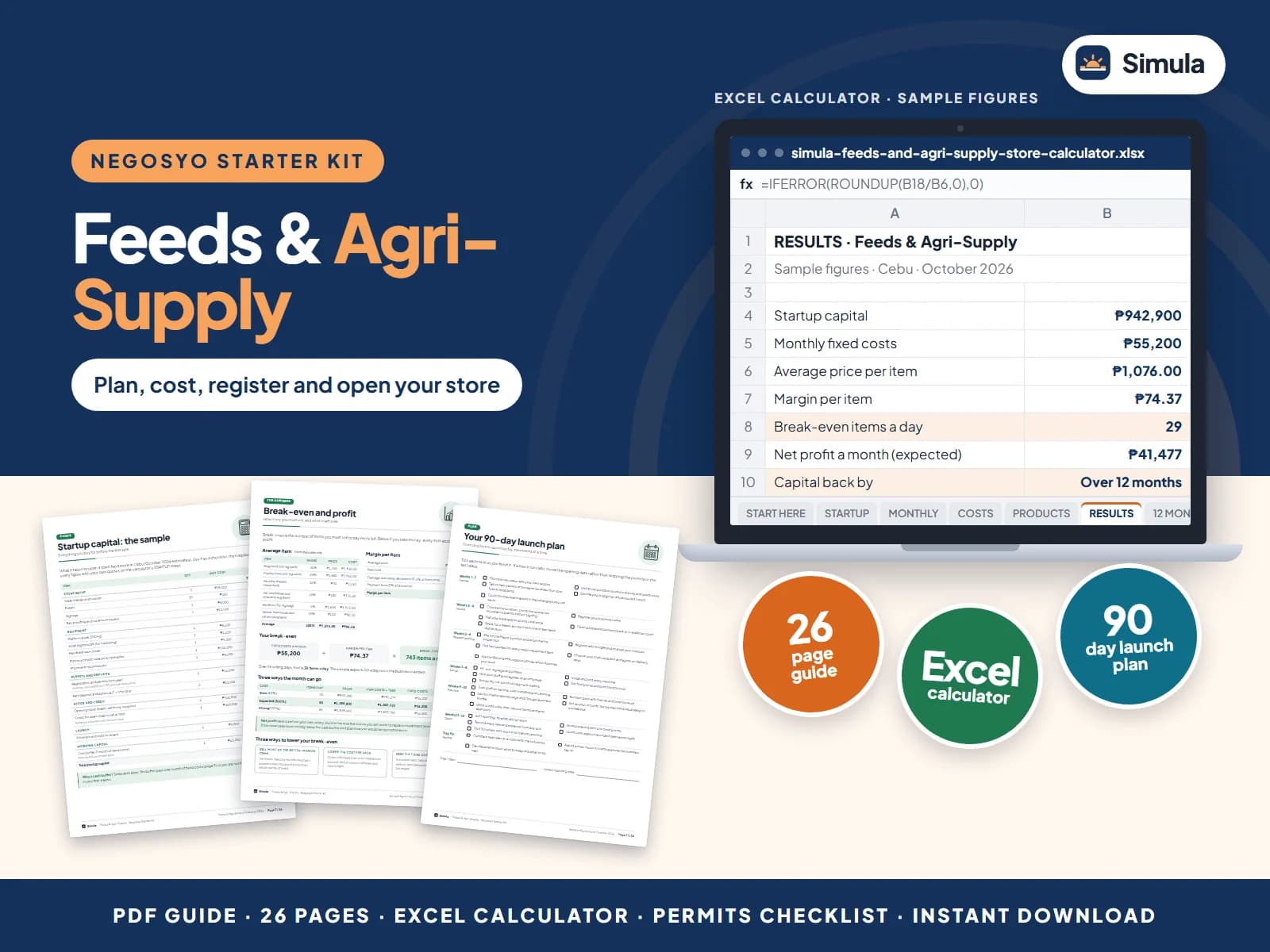
- Sample startup capital: ₱942,900 (October 2026, Cebu).
- Break-even: 29 items a day.
- Register with DTI, the barangay, the city (Mayor's permit) and BIR; also BAI licence to operate (feed retailer), FPA licence (fertilizer or pesticides) and scale inspection and sealing.
A feeds and agri-supply store sells hog and poultry feeds, vet medicines and farm supplies to backyard raisers and small farms. Most start in a farming town with a dry store, a dealer account with a feed distributor and a motorcycle for deliveries. Margins per sack are thin; the money is made on regular raisers, vet and small items, and credit that is collected at harvest.
This guide walks through what it takes to start a feeds and agri-supply store in the Philippines: the capital, the monthly costs, the permits and the first 90 days. The peso figures are sample estimates for a town feed store in Cebu as of October 2026; get your own quotes before you decide.
How much capital you need
The sample comes to about ₱942,900 including one month of fixed costs kept as a cash buffer. It splits into store setup (₱55,500), equipment (₱133,200), permits and deposits (₱45,000), stock and credit (₱650,000), launch (₱4,000) and working capital (₱55,200). Other ways to start: barangay feeds corner at ₱150,000–₱300,000 and agri-vet supply with a vet at ₱2 million and up.
Monthly costs and break-even
Fixed costs in the sample are ₱55,200 a month; the biggest are helpers' wages (₱31,200), store rent (₱10,000) and SSS, PhilHealth and Pag-IBIG (₱4,350). Each item sold earns about ₱74 after its own costs, so the break-even is 29 items a day, and the startup capital takes about 23 months to come back at full sales.
Permits and registration
Register the business name with DTI (or SEC or CDA), then get the barangay business clearance, the Mayor's permit through the city or municipal BPLO, and BIR registration; register with SSS, PhilHealth and Pag-IBIG once you hire. A feeds and agri-supply store also needs: BAI licence to operate (feed retailer), FPA licence (fertilizer or pesticides) and scale inspection and sealing. Requirements and fees differ by city, so ask each office for its checklist first. DTI Negosyo Centers help for free.
Where to set up
- In a farming town center where raisers come on market day
- Along the main road to farming barangays
- Near the public market or a tricycle terminal
- Where the nearest feed store is far away
Mistakes to avoid
- Credit is not paid at harvest. A limit per raiser, harvest dates written down, and no new credit while a balance is overdue.
- A disease outbreak empties the pens. Sell to several kinds of raisers (hogs, poultry, pets), and cut credit when an outbreak is near.
- Sacks spoil from damp or rats. Pallets, a dry storeroom, rat control, and first in, first out.
- Feed prices rise suddenly. Keep two to three weeks of stock, and update prices when your distributor changes them.
Plan it with the starter kit
The Feeds & Agri-Supply · Negosyo Starter Kit has every worksheet behind this guide in a 26-page PDF, plus an Excel calculator: type in your own quotes and it works out your capital, break-even, profit and payback month. It costs ₱349 and downloads right after payment.