Key takeaways
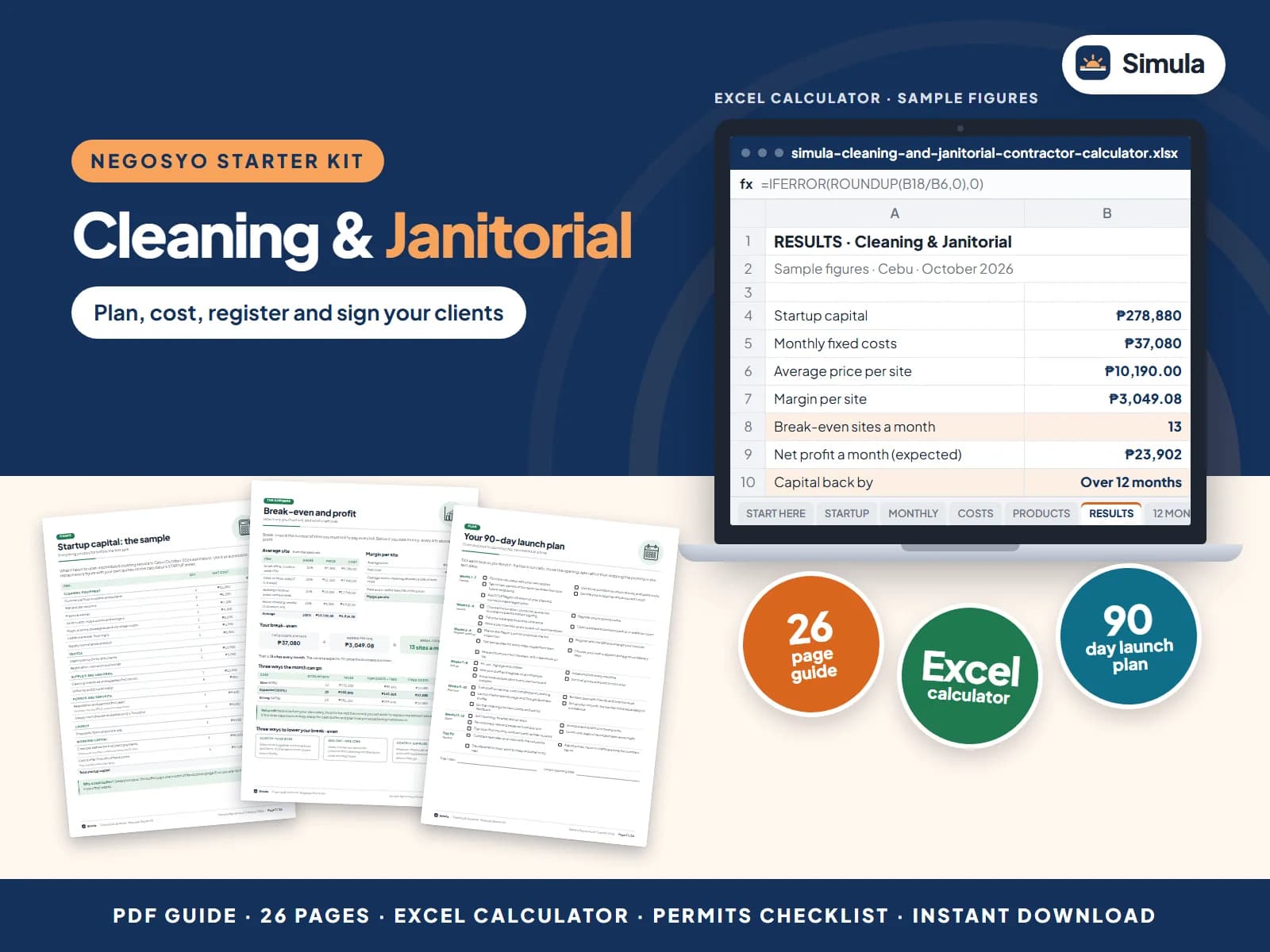
- Sample startup capital: ₱278,880 (October 2026, Cebu).
- Break-even: 13 sites a month.
- Register with DTI, the barangay, the city (Mayor's permit) and BIR; also DOLE registration as a contractor, work permit at each client building and clearances for your cleaners.
A cleaning contractor cleans offices, clinics, shops, building common areas and homes on a fixed schedule for a monthly rate. Most start with the owner supervising a few trained cleaners who travel to each site, with the equipment kept in a small supply room. The money is in steady monthly contracts, crews scheduled tightly between sites, and supplies used by measure.
This guide walks through what it takes to start a cleaning and janitorial business in the Philippines: the capital, the monthly costs, the permits and the first 90 days. The peso figures are sample estimates for a scheduled cleaning service in Cebu as of October 2026; get your own quotes before you decide.
How much capital you need
The sample comes to about ₱278,880 including one month of fixed costs kept as a cash buffer. It splits into cleaning equipment (₱80,000), vehicle (₱60,000), supplies and uniforms (₱19,200), permits and deposits (₱27,600), launch (₱5,000) and working capital (₱87,080). Other ways to start: deep and post-construction cleaning at ₱400,000–₱700,000 and janitorial contractor (dole-registered) at Net worth of ₱5M or more.
Monthly costs and break-even
Fixed costs in the sample are ₱37,080 a month; the biggest are reliever cleaner (₱15,600), supply room rent (₱6,000) and motorcycle fuel and upkeep (₱3,500). Each site sold earns about ₱3,049 after its own costs, so the break-even is 13 sites a month, and the startup capital takes about 12 months to come back at full sales.
Permits and registration
Register the business name with DTI (or SEC or CDA), then get the barangay business clearance, the Mayor's permit through the city or municipal BPLO, and BIR registration; register with SSS, PhilHealth and Pag-IBIG once you hire. A cleaning and janitorial business also needs: DOLE registration as a contractor, work permit at each client building and clearances for your cleaners. Requirements and fees differ by city, so ask each office for its checklist first. DTI Negosyo Centers help for free.
Where to set up
- Near business districts with many small offices
- Near clinics, hospitals and medical buildings
- Areas with condos and apartment buildings
- On jeepney routes your cleaners can use cheaply
Mistakes to avoid
- Cleaners absent or late. Keep a reliever, schedule realistic hours and pay on time; most turnover comes from late pay.
- Theft or damage at a client site. Clearances on file, the same crew at the same sites, sign-in sheets and a set-aside for damage.
- Clients pay late. Bill on a fixed date each month, write the payment term into the contract, and pause service after a set number of days.
- Breaking labour rules. Minimum wage, payslips, SSS, PhilHealth, Pag-IBIG and 13th month for every cleaner; ask DOLE before posting janitors.
Plan it with the starter kit
The Cleaning & Janitorial · Negosyo Starter Kit has every worksheet behind this guide in a 26-page PDF, plus an Excel calculator: type in your own quotes and it works out your capital, break-even, profit and payback month. It costs ₱349 and downloads right after payment.