Key takeaways
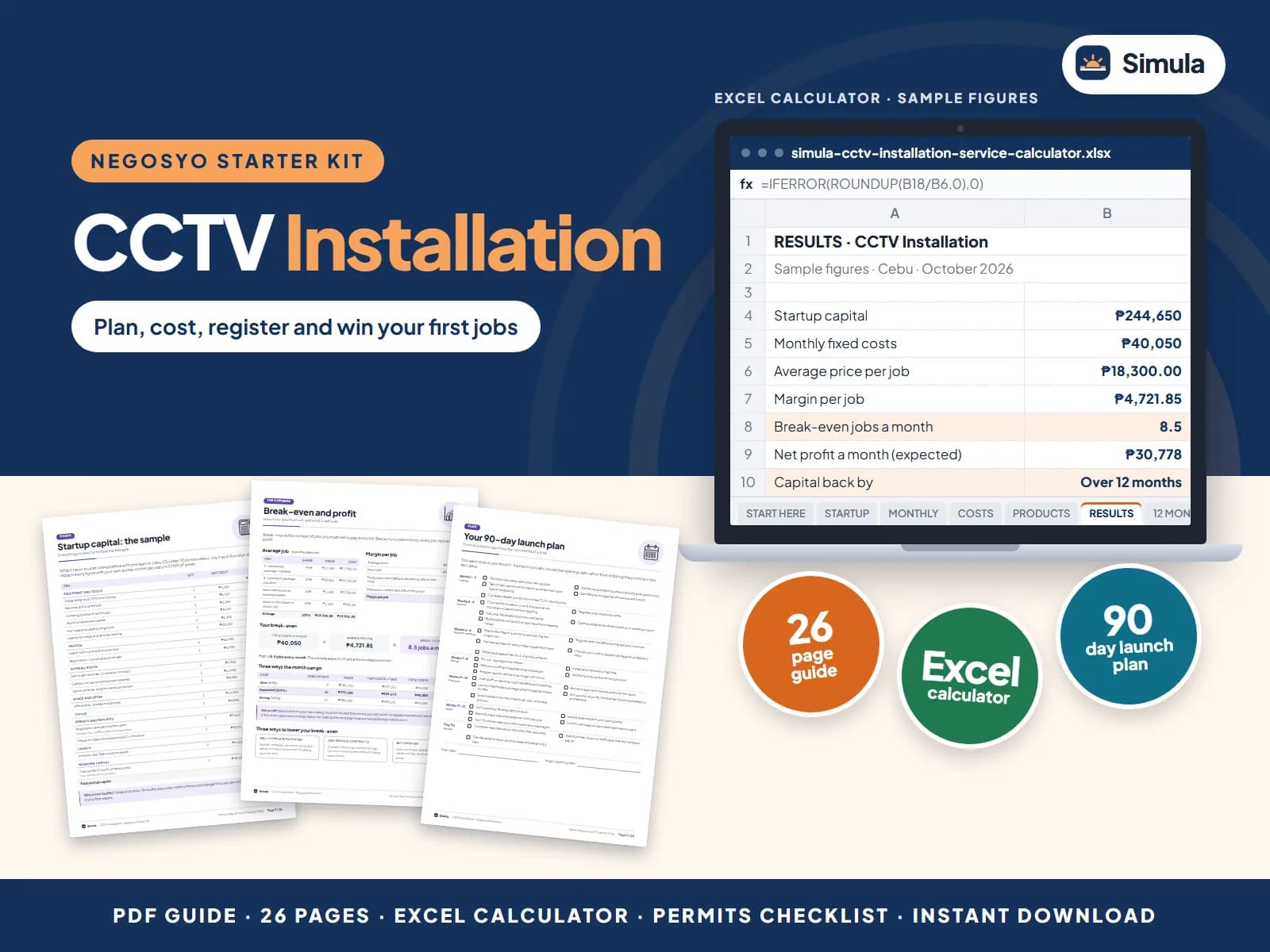
- Sample startup capital: ₱244,650 (October 2026, Cebu).
- Break-even: 8.5 jobs a month.
- Register with DTI, the barangay, the city (Mayor's permit) and BIR; also work permit at the client's building, CCTV privacy guidance for business clients and contractor's licence for large projects.
A CCTV installation service sells, installs and maintains security cameras for homes, stores, offices and boarding houses. Most start with one technician and a helper, a motorcycle and a small office, buying the cameras for each job from distributors. The money is in a fair margin on every package, neat installation, and service visits that bring clients back.
This guide walks through what it takes to start a CCTV installation service in the Philippines: the capital, the monthly costs, the permits and the first 90 days. The peso figures are sample estimates for a small office with one team in Cebu as of October 2026; get your own quotes before you decide.
How much capital you need
The sample comes to about ₱244,650 including one month of fixed costs kept as a cash buffer. It splits into equipment and tools (₱51,000), vehicle (₱66,000), opening stock (₱29,000), space and setup (₱19,000), permits and deposits (₱33,600), launch (₱6,000) and working capital (₱40,050). Other ways to start: security systems shop at ₱600,000–₱1 million and contractor for buildings at ₱2 million and up.
Monthly costs and break-even
Fixed costs in the sample are ₱40,050 a month; the biggest are technician wage (₱18,200), small office and stockroom rent (₱8,000) and SSS, PhilHealth and Pag-IBIG (₱2,550). Each job sold earns about ₱4,722 after its own costs, so the break-even is 8.5 jobs a month, and the startup capital takes about 8 months to come back at full sales.
Permits and registration
Register the business name with DTI (or SEC or CDA), then get the barangay business clearance, the Mayor's permit through the city or municipal BPLO, and BIR registration; register with SSS, PhilHealth and Pag-IBIG once you hire. A CCTV installation service also needs: work permit at the client's building, CCTV privacy guidance for business clients and contractor's licence for large projects. Requirements and fees differ by city, so ask each office for its checklist first. DTI Negosyo Centers help for free.
Where to set up
- A commercial strip with many small businesses
- Near new subdivisions and housing projects
- Near hardware and electronics stores
- Along a main road clients can find easily
Mistakes to avoid
- A client does not pay the balance. A downpayment that covers materials before you buy, and the balance due on the day of turnover.
- Cameras fail under warranty. Buy from distributors who replace defects quickly, and keep the serial number of every unit.
- Hacked or exposed cameras. Change default passwords, update the recorder's software, and teach clients not to share logins.
- Falls and electric shock. Sturdy ladders, a second person holding them, and power off before touching any wiring.
Plan it with the starter kit
The CCTV Installation · Negosyo Starter Kit has every worksheet behind this guide in a 26-page PDF, plus an Excel calculator: type in your own quotes and it works out your capital, break-even, profit and payback month. It costs ₱349 and downloads right after payment.
