Key takeaways
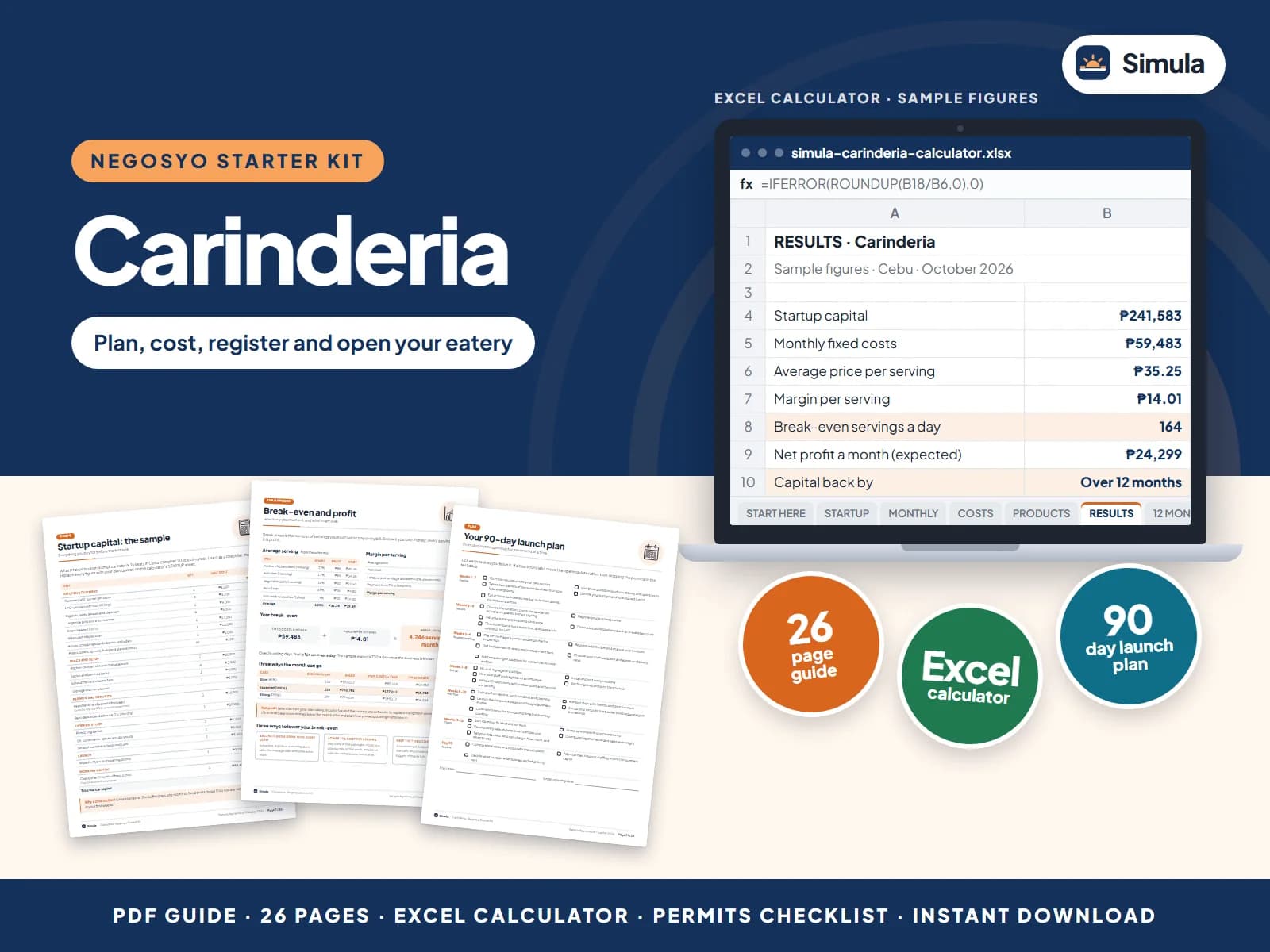
- Sample startup capital: ₱241,583 (October 2026, Cebu).
- Break-even: 164 servings a day.
- Register with DTI, the barangay, the city (Mayor's permit) and BIR; also sanitary permit and health certificates for every food handler.
A carinderia sells home-style rice meals from ready-cooked ulam in a display, to eat in or take out. Most start in a small rented space near a market, school, terminal or worksite, with the owner as the main cook. The money is made by cooking the right amount every day, keeping portions fixed and selling rice and a drink with every ulam.
This guide walks through what it takes to start a carinderia in the Philippines: the capital, the monthly costs, the permits and the first 90 days. The peso figures are sample estimates for a small carinderia, 16 seats in Cebu as of October 2026; get your own quotes before you decide.
How much capital you need
The sample comes to about ₱241,583 including one month of fixed costs kept as a cash buffer. It splits into kitchen equipment (₱70,900), space and setup (₱50,000), permits and deposits (₱46,000), opening stock (₱12,200), launch (₱3,000) and working capital (₱59,483). Other ways to start: turo-turo stall in a market or terminal at ₱80,000–₱150,000 and school or office canteen concession at ₱300,000–₱500,000.
Monthly costs and break-even
Fixed costs in the sample are ₱59,483 a month; the biggest are helper wages (₱31,200), rent (₱12,000) and SSS, PhilHealth and Pag-IBIG (₱4,350). Each serving sold earns about ₱14 after its own costs, so the break-even is 164 servings a day, and the startup capital takes about 10 months to come back at full sales.
Permits and registration
Register the business name with DTI (or SEC or CDA), then get the barangay business clearance, the Mayor's permit through the city or municipal BPLO, and BIR registration; register with SSS, PhilHealth and Pag-IBIG once you hire. A carinderia also needs: sanitary permit and health certificates for every food handler. Requirements and fees differ by city, so ask each office for its checklist first. DTI Negosyo Centers help for free.
Where to set up
- Near a public market, bagsakan or transport terminal
- Beside a construction site, factory or warehouse area
- Within walking distance of a school or college
- Along a main road where drivers can stop or park
Mistakes to avoid
- Too much food left at closing. Cook to a plan by day of the week, cook a second batch only of what sells, and log leftovers daily.
- Lista credit that is never paid. Give credit only to known regulars, set a limit for each, and collect every payday.
- Food poisoning or a failed inspection. Cover food, keep it hot, store raw meat apart, and train helpers on handwashing and cleaning.
- Meat and fish prices jump. Check prices weekly, keep cheaper dishes on the menu, and review prices monthly.
Plan it with the starter kit
The Carinderia · Negosyo Starter Kit has every worksheet behind this guide in a 26-page PDF, plus an Excel calculator: type in your own quotes and it works out your capital, break-even, profit and payback month. It costs ₱349 and downloads right after payment.
