Key takeaways
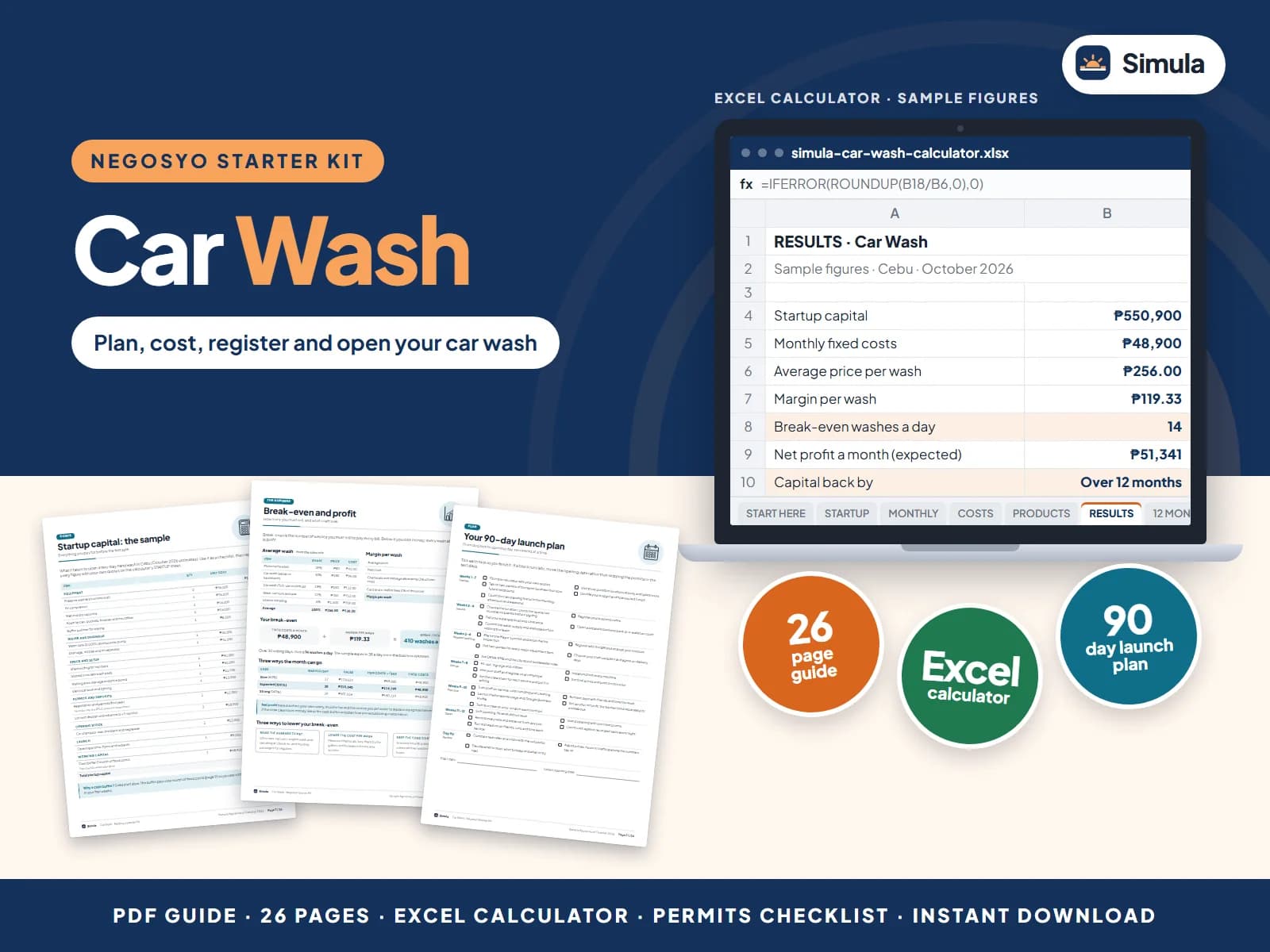
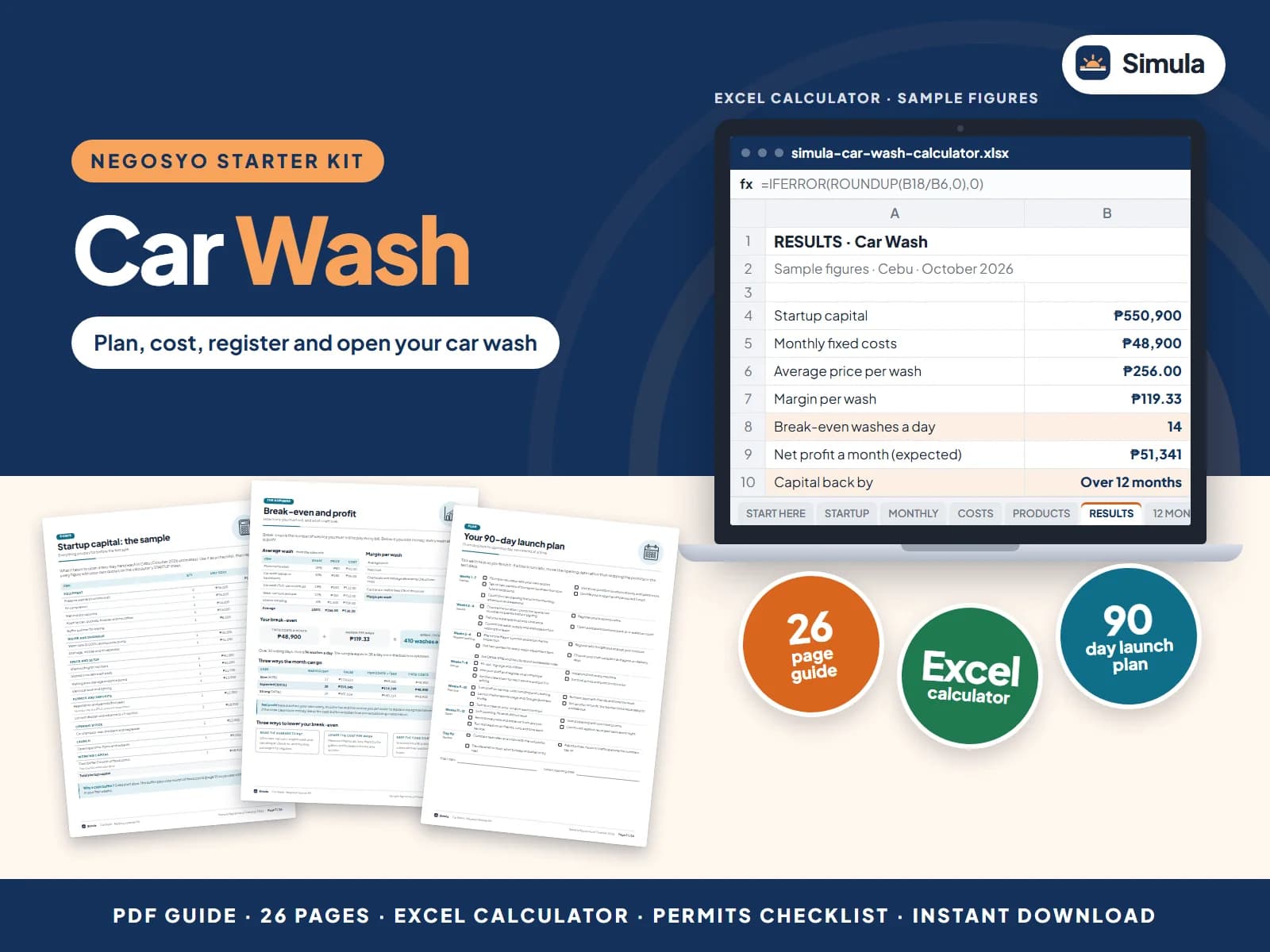
- Sample startup capital: ₱550,900 (October 2026, Cebu).
- Break-even: 14 washes a day.
- Register with DTI, the barangay, the city (Mayor's permit) and BIR; also water permit for a deep well (if you drill), wastewater discharge permit (ask first) and sanitary permit.
A car wash cleans cars, SUVs and motorcycles by hand, and adds waxing, vacuuming and interior detailing for customers who want more. Most start on a rented lot along a busy road with two wash bays and a crew paid a share of each wash. The money is made on steady traffic, a reliable water supply, and add-ons that raise the average ticket.
This guide walks through what it takes to start a car wash in the Philippines: the capital, the monthly costs, the permits and the first 90 days. The peso figures are sample estimates for a two-bay hand wash in Cebu as of October 2026; get your own quotes before you decide.
How much capital you need
The sample comes to about ₱550,900 including one month of fixed costs kept as a cash buffer. It splits into equipment (₱148,000), water and drainage (₱75,000), space and setup (₱190,000), permits and deposits (₱69,000), opening stock (₱15,000), launch (₱5,000) and working capital (₱48,900). Other ways to start: motorcycle wash corner at ₱80,000–₱150,000 and car wash with a detailing shop at ₱1.5 million–₱3 million.
Monthly costs and break-even
Fixed costs in the sample are ₱48,900 a month; the biggest are lot rent (₱18,000), cashier and supervisor (₱16,900) and electricity (₱3,000). Each wash sold earns about ₱119 after its own costs, so the break-even is 14 washes a day, and the startup capital takes about 11 months to come back at full sales.
Permits and registration
Register the business name with DTI (or SEC or CDA), then get the barangay business clearance, the Mayor's permit through the city or municipal BPLO, and BIR registration; register with SSS, PhilHealth and Pag-IBIG once you hire. A car wash also needs: water permit for a deep well (if you drill), wastewater discharge permit (ask first) and sanitary permit. Requirements and fees differ by city, so ask each office for its checklist first. DTI Negosyo Centers help for free.
Where to set up
- On a main road with slow traffic, where drivers can turn in
- Near subdivisions with many car owners
- Beside a gas station, restaurant or shopping strip
- Near offices with parking, for workday washes
Mistakes to avoid
- A customer's car is scratched. A walk-around check at drop-off, clean microfiber, a no-scratch method and a written damage policy.
- The water runs out. A storage tank, a permitted deep well, or a water delivery contact.
- Complaints about dirty runoff. A silt trap and oil separator cleaned every day, and no wash water on the road.
- Crew leave for another car wash. Fair shares paid on time, and benefits paid as the law requires.
Plan it with the starter kit
The Car Wash · Negosyo Starter Kit has every worksheet behind this guide in a 26-page PDF, plus an Excel calculator: type in your own quotes and it works out your capital, break-even, profit and payback month. It costs ₱349 and downloads right after payment.