Key takeaways
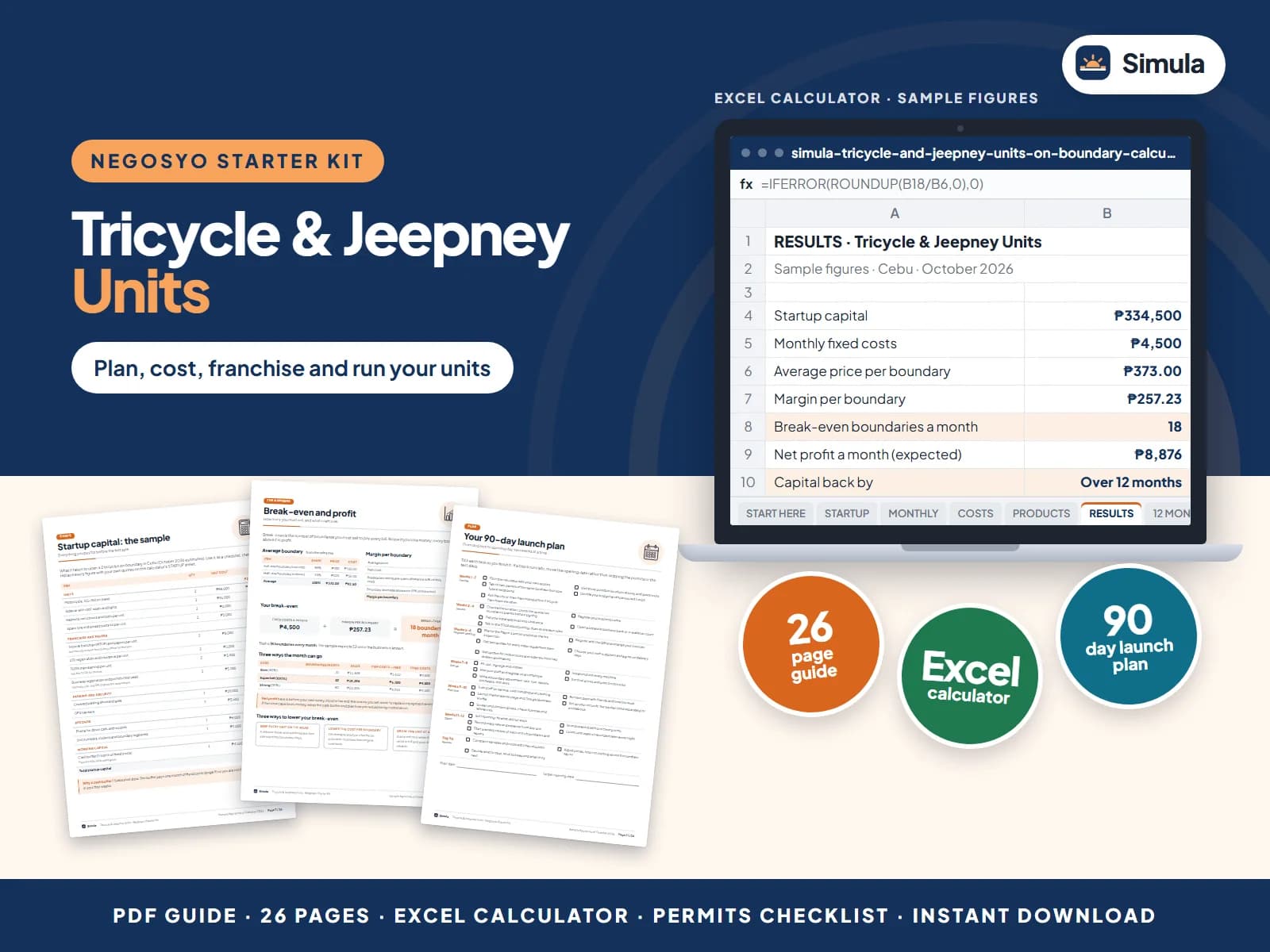
- Sample startup capital: ₱334,500 (October 2026, Cebu).
- Break-even: 18 boundaries a month.
- Register with DTI, the barangay, the city (Mayor's permit) and BIR; also tricycle franchise (MTOP) per unit, TODA membership, LTO registration and insurance per unit and jeepney franchise (if you add jeepneys).
A boundary business earns from tricycles or jeepneys driven by drivers who pay the owner a fixed daily boundary and keep the rest of the fares. Most start with one or two tricycles with a city or town franchise, and add units over time. The money is made on units that run every day, drivers who remit in full, and maintenance done before small problems become big repairs.
This guide walks through what it takes to start a boundary transport business in the Philippines: the capital, the monthly costs, the permits and the first 90 days. The peso figures are sample estimates for a 2 tricycles on boundary in Cebu as of October 2026; get your own quotes before you decide.
How much capital you need
The sample comes to about ₱334,500 including one month of fixed costs kept as a cash buffer. It splits into units (₱258,000), franchise and papers (₱37,000), parking and security (₱27,000), records (₱8,000) and working capital (₱4,500). Other ways to start: modern jeepney in a cooperative at ₱2.5 million and up and small tricycle fleet (5–8 units) at ₱800,000–₱1.5 million.
Monthly costs and break-even
Fixed costs in the sample are ₱4,500 a month; the biggest are LTO registration and insurance set aside (₱1,000), parking and night security (₱1,000) and engine and sidecar repairs set aside (₱1,000). Each boundary sold earns about ₱257 after its own costs, so the break-even is 18 boundaries a month, and the startup capital takes about 38 months to come back at full sales.
Permits and registration
Register the business name with DTI (or SEC or CDA), then get the barangay business clearance, the Mayor's permit through the city or municipal BPLO, and BIR registration; register with SSS, PhilHealth and Pag-IBIG once you hire. A boundary transport business also needs: tricycle franchise (MTOP) per unit, TODA membership, LTO registration and insurance per unit and jeepney franchise (if you add jeepneys). Requirements and fees differ by city, so ask each office for its checklist first. DTI Negosyo Centers help for free.
Where to set up
- A TODA zone with steady riders and room for more units
- Routes linking highways to big subdivisions
- Near schools, markets and public terminals
- Towns where tricycles are the main short-trip ride
Mistakes to avoid
- Drivers short on the boundary. Record every shortage, settle it weekly, and replace drivers who are often short.
- A unit is stolen or crashes. Screened drivers, GPS trackers, locked parking, and insurance kept current.
- Franchise or papers expire. List every expiry date and renew a month early; a unit with expired papers cannot run.
- Labour claims from drivers. Boundary drivers may count as employees under labour rules; ask SSS and DOLE what you must remit.
Plan it with the starter kit
The Tricycle & Jeepney Units · Negosyo Starter Kit has every worksheet behind this guide in a 26-page PDF, plus an Excel calculator: type in your own quotes and it works out your capital, break-even, profit and payback month. It costs ₱349 and downloads right after payment.