Key takeaways
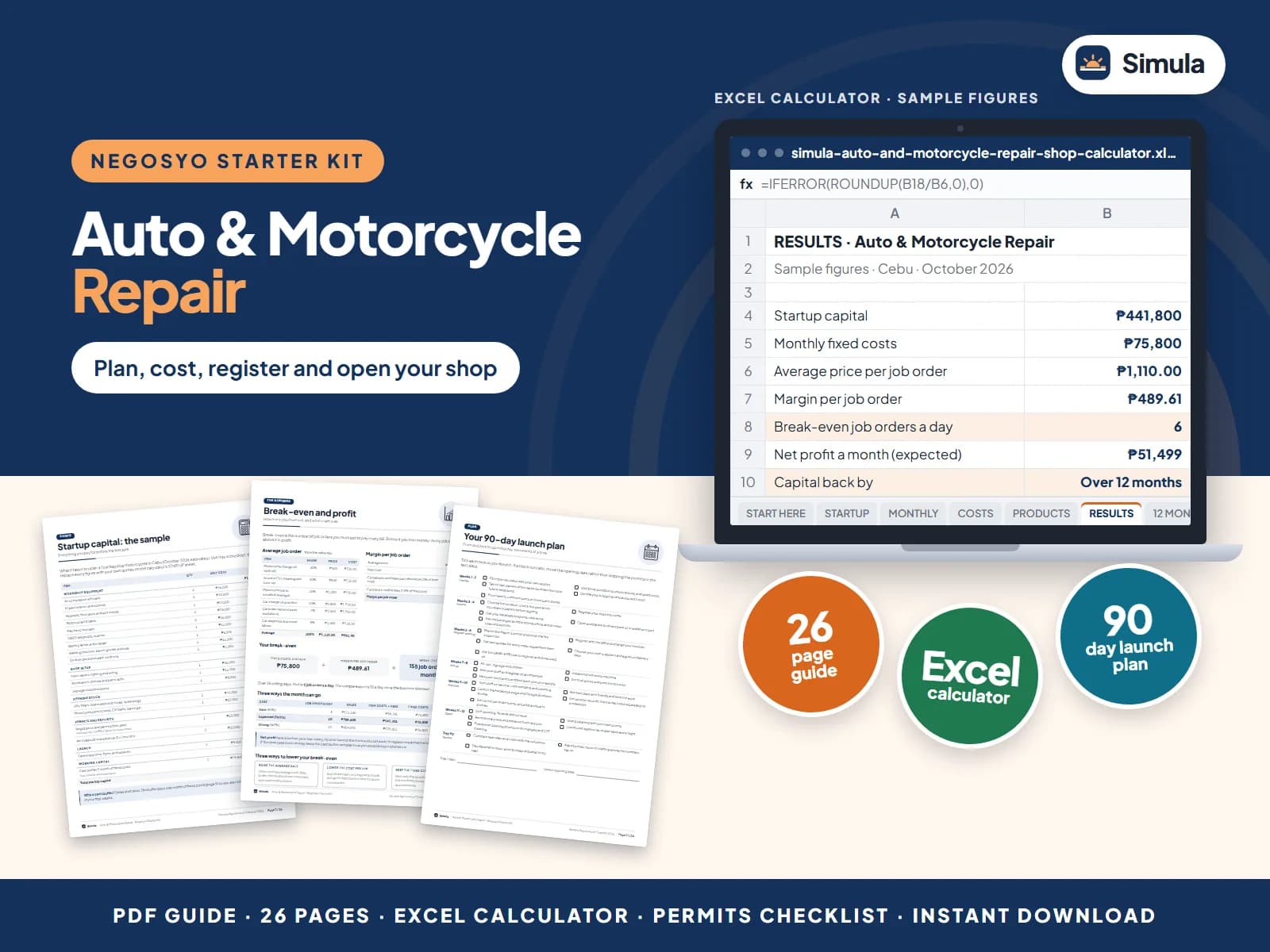
- Sample startup capital: ₱441,800 (October 2026, Cebu).
- Break-even: 6 job orders a day.
- Register with DTI, the barangay, the city (Mayor's permit) and BIR; also hazardous waste generator registration, zoning and noise rules (ask) and TESDA certificates for mechanics (optional).
An auto and motorcycle repair shop services and fixes the vehicles people depend on every day: oil changes, tune-ups, brakes, scooter CVT cleaning and parts replacement. Most start as a small street-front shop with one bay for cars and space for motorcycles, two mechanics and the owner at the counter. The money is made on steady service jobs, honest quotes, and parts bought well and installed right the first time.
This guide walks through what it takes to start an auto and motorcycle repair shop in the Philippines: the capital, the monthly costs, the permits and the first 90 days. The peso figures are sample estimates for a 1 car bay plus motorcycles in Cebu as of October 2026; get your own quotes before you decide.
How much capital you need
The sample comes to about ₱441,800 including one month of fixed costs kept as a cash buffer. It splits into workshop equipment (₱138,000), shop setup (₱53,000), opening stock (₱95,000), permits and deposits (₱75,000), launch (₱5,000) and working capital (₱75,800). Other ways to start: motorcycle-only service shop at ₱200,000–₱350,000 and auto shop with lifts and diagnostics at ₱1.5 million and up.
Monthly costs and break-even
Fixed costs in the sample are ₱75,800 a month; the biggest are mechanics (₱36,400), rent (₱20,000) and SSS, PhilHealth and Pag-IBIG (₱5,100). Each job order sold earns about ₱490 after its own costs, so the break-even is 6 job orders a day, and the startup capital takes about 9 months to come back at full sales.
Permits and registration
Register the business name with DTI (or SEC or CDA), then get the barangay business clearance, the Mayor's permit through the city or municipal BPLO, and BIR registration; register with SSS, PhilHealth and Pag-IBIG once you hire. An auto and motorcycle repair shop also needs: hazardous waste generator registration, zoning and noise rules (ask) and TESDA certificates for mechanics (optional). Requirements and fees differ by city, so ask each office for its checklist first. DTI Negosyo Centers help for free.
Where to set up
- On a main road with many motorcycles and cars passing
- Near terminals, markets and tricycle routes
- Close to dense residential areas and subdivisions
- Near parts stores, so parts arrive quickly
Mistakes to avoid
- A customer disputes a repair or bill. Written quotes, the customer's OK before extra work, old parts shown, and a short labour warranty.
- Injury in the workshop. Jack stands under every lifted vehicle, goggles and gloves, and a dry, clean floor.
- Fake or poor-quality parts. Buy from known suppliers, keep receipts, and track failed parts by supplier.
- Damage to a customer's vehicle. Note existing damage at intake, lock vehicles in at night, and test-drive only with the owner's OK.
Plan it with the starter kit
The Auto & Motorcycle Repair · Negosyo Starter Kit has every worksheet behind this guide in a 26-page PDF, plus an Excel calculator: type in your own quotes and it works out your capital, break-even, profit and payback month. It costs ₱349 and downloads right after payment.