Key takeaways
- Structure replies with an acknowledgment, confirmed answer, next step, and update time.
- Organize saved responses by customer situation instead of by selling platform.
- Replace every placeholder and verify changing facts before sending.
- Protect customer privacy and review saved replies whenever shop rules change.
Fast replies help, but speed alone is not enough. A rushed answer can leave out the price, stock status, next step, or promised update time. A copied answer can also sound cold when it does not match the customer’s question.
Filipino micro and small businesses are continuing to use digital marketplaces, short-form video, live selling, and chat-based customer journeys. TikTok Shop reported in August 2026 that more than 90% of its sellers are local businesses. This makes a repeatable reply process useful even for a one-person shop.
Use the four-part reply method
A reliable customer reply usually needs four parts:
- Acknowledge. Show that you understood the question or concern.
- Answer. Give the confirmed price, stock status, order update, or policy information.
- Next step. Tell the customer what to choose, send, confirm, or expect.
- Update time. If the issue is not resolved now, state when you will message again.
For example: “I’m sorry the parcel has not moved since Tuesday. We checked the tracking and raised a follow-up with the courier. Reference: 12345. We’ll update you tomorrow by 3 PM.” The customer now knows that the concern was understood, what was checked, and when the next message will arrive.
Save replies by situation—not by platform
Organize saved replies around customer needs such as price, stock, size, COD, payment verification, shipping, delay, damaged item, return request, and review follow-up. The same core reply can then be adapted for Messenger, TikTok Shop, Shopee, Lazada, Instagram, or SMS.
Keep placeholders obvious
Use visible fields such as [Customer Name], [Product], [Price], [Order Number], and [Next Update]. Never send a template until every bracketed field is replaced. Verify facts that can change, especially stock, prices, promotions, shipping estimates, and refund timelines.
Protect customer information
Use official shop channels and collect only the information needed for the order. Never ask a customer for a password, PIN, or OTP. When requesting payment proof, let the buyer cover unrelated balances or private account details.
Review the library every month
Saved replies become risky when old prices, courier promises, or return rules remain inside them. Schedule a short monthly review and update any message affected by a policy or operational change.
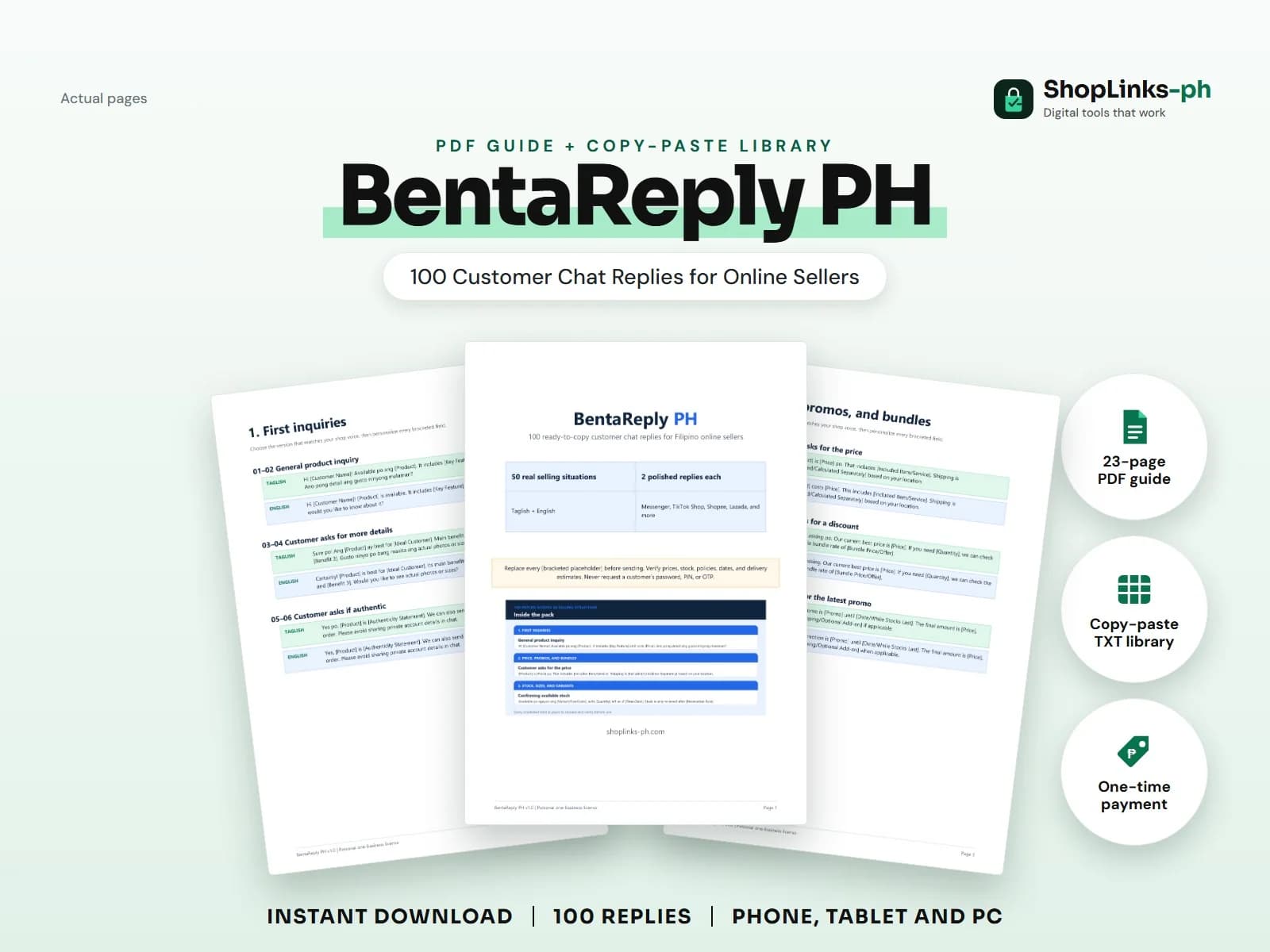
BentaReply PH turns this method into 100 ready-to-customize Taglish and English replies across 50 common seller situations.
Templates support consistency but do not replace marketplace rules, consumer obligations, shop policies, privacy practices, or legal advice.