Key takeaways
- Markup is calculated on cost; margin is calculated on selling price.
- A 50% markup produces a 33.3% margin before other costs.
- Percentage selling fees should be included in a fee-aware pricing formula.
- Compare estimated product margin with actual monthly net profit.
Watch the supporting video
Watch the YouTube guide here while following this article.
Markup and profit margin both describe the relationship between cost and price, but they use different starting points. Mixing them up can produce a selling price that earns less than you planned.
The difference in one example
Suppose one product costs ₱100 before selling fees and you add a 50% markup.
Price = cost × (1 + markup) = ₱100 × 1.50 = ₱150.
The peso profit is ₱50. But the profit margin is not 50%:
Margin = profit ÷ price = ₱50 ÷ ₱150 = 33.3%.
A 50% markup on cost therefore produces a 33.3% margin on sales.
How to price for a target margin
If your direct cost is ₱100 and you want a 40% margin with no percentage fee:
Price = cost ÷ (1 − target margin) = ₱100 ÷ 0.60 = ₱166.67.
At that price, estimated profit is ₱66.67, which is 40% of ₱166.67.
Add platform or payment fees correctly
A percentage fee is normally based on the selling price, so simply adding it to the cost can understate the required price. Include the rate in the denominator:
Price = direct cost ÷ (1 − target margin − fee rate).
For ₱100 cost, a 30% target margin, and an 8% selling fee:
₱100 ÷ (1 − 0.30 − 0.08) = ₱161.29.
At this price, the estimated fee is ₱12.90 and estimated profit is ₱48.39, equal to 30% of the selling price.
Which measure should you use?
Markup is convenient when applying a quick multiplier to cost. Margin is usually more useful for comparing products and tracking how much of each sales peso remains after the costs included in your calculation.
Neither number tells the complete story by itself. Be clear about which costs are included. A gross product margin may include ingredients and packaging but leave out rent, marketing, transport, refunds, and other operating expenses. Monthly net profit can therefore be much lower.
A practical pricing checklist
- Use current ingredient prices and realistic sellable yield.
- Add packaging, labor, utilities, overhead, and expected wastage.
- Include applicable platform or payment rates.
- Calculate the price required for your target margin.
- Review the resulting peso profit and customer value.
- Record actual sales, fees, discounts, and expenses.
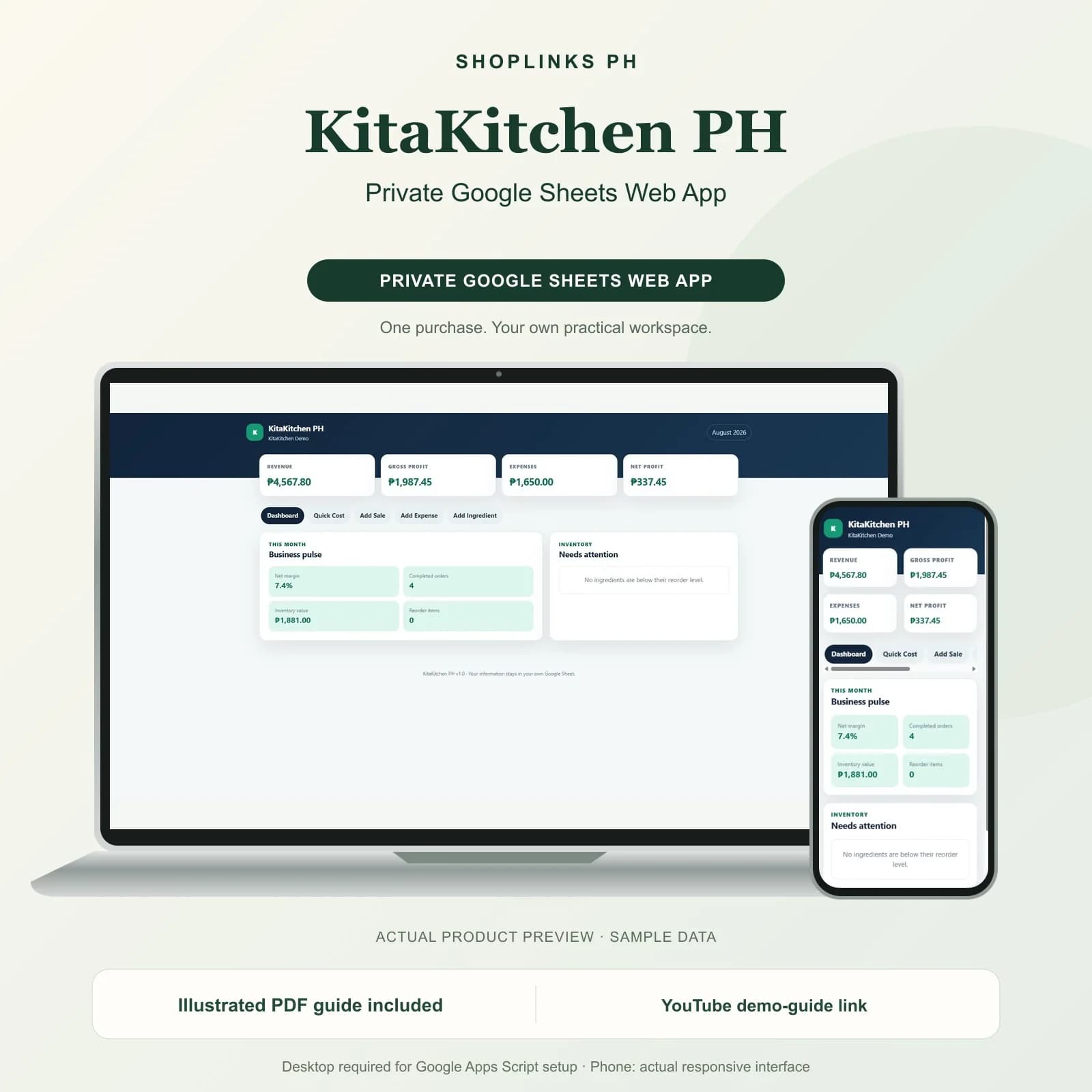
KitaKitchen PH Private Web App Edition includes a quick-cost calculator for cost per serving, suggested price, fee-aware profit, and margin, plus a private Sheet-backed dashboard and entry forms.
All examples are simplified planning illustrations. Confirm applicable taxes, fees, and business obligations with qualified professionals and official sources.