Key takeaways
- Write the recurring scope down per client.
- One log row per client per period with a due date.
- Status is computed, so nothing needs a reminder list.
- Retainer billing shows balance and payment status.
Watch the supporting video
Watch the YouTube guide here while following this article.
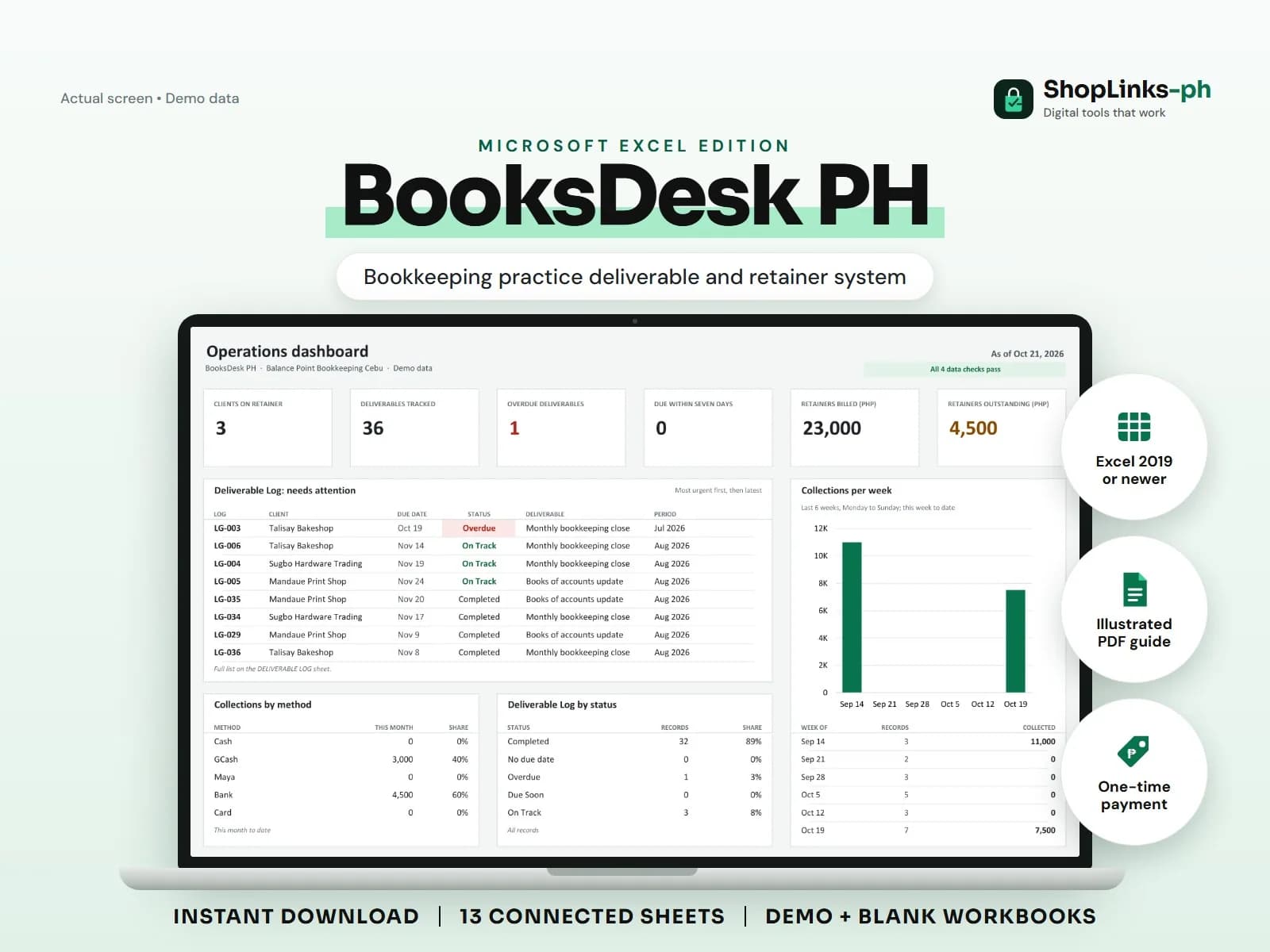
A bookkeeping practice does not fail on skill, it fails on volume. Ten clients times three recurring deliverables is thirty small promises a month, each with its own date, and the one that slips is always the quiet client nobody asked about. BooksDesk PH turns that into a single log where each client and period gets a row, a due date, and a status that reads On Track, Due Soon, or Overdue on its own.
Write down the recurring scope
Deliverable types are listed once with their frequency and usual due day. Each client is then assigned the deliverables their account actually needs, which is the scope your retainer covers.
That list is worth having on paper. It settles the question of what is included long before an argument about extra work.
One row per client per period
The log is where the work lives. Each row carries the client, the deliverable, the period, the due date, and the staff member responsible.
Days to due and the status are computed, so nobody has to maintain a separate reminder list. Entering the completion date clears the row from the open count.
Read the workload, not the inbox
WORKLOAD BOARD totals each staff member's clients, open items, due soon, overdue, and completed counts. That is the Monday morning picture in one screen.
When one person carries every overdue item, the board shows it before the client does.
Bill the retainer and follow the balance
A billing row reads the client's retainer, adds extra charges, subtracts any discount, and computes the total. Collections are recorded against the billing.
Balance and a Paid, Partial, or Unpaid status follow, so the follow-up list is a filter rather than a reconstruction from bank messages.
Review exceptions every week
Resolve duplicate IDs, missing links, overdue balances, negative amounts, and open operational items in CHECKS before using the dashboard for decisions.
BooksDesk PH Microsoft Excel Edition is designed for Microsoft Excel 2019 or newer on Windows or macOS.
No BIR electronic filing through eFPS or eBIRForms, no tax computation, tax advice or return preparation, no audited financial statements, no accounting-software or bank-feed sync, no payroll processing, official receipts, or any submission to a government agency.