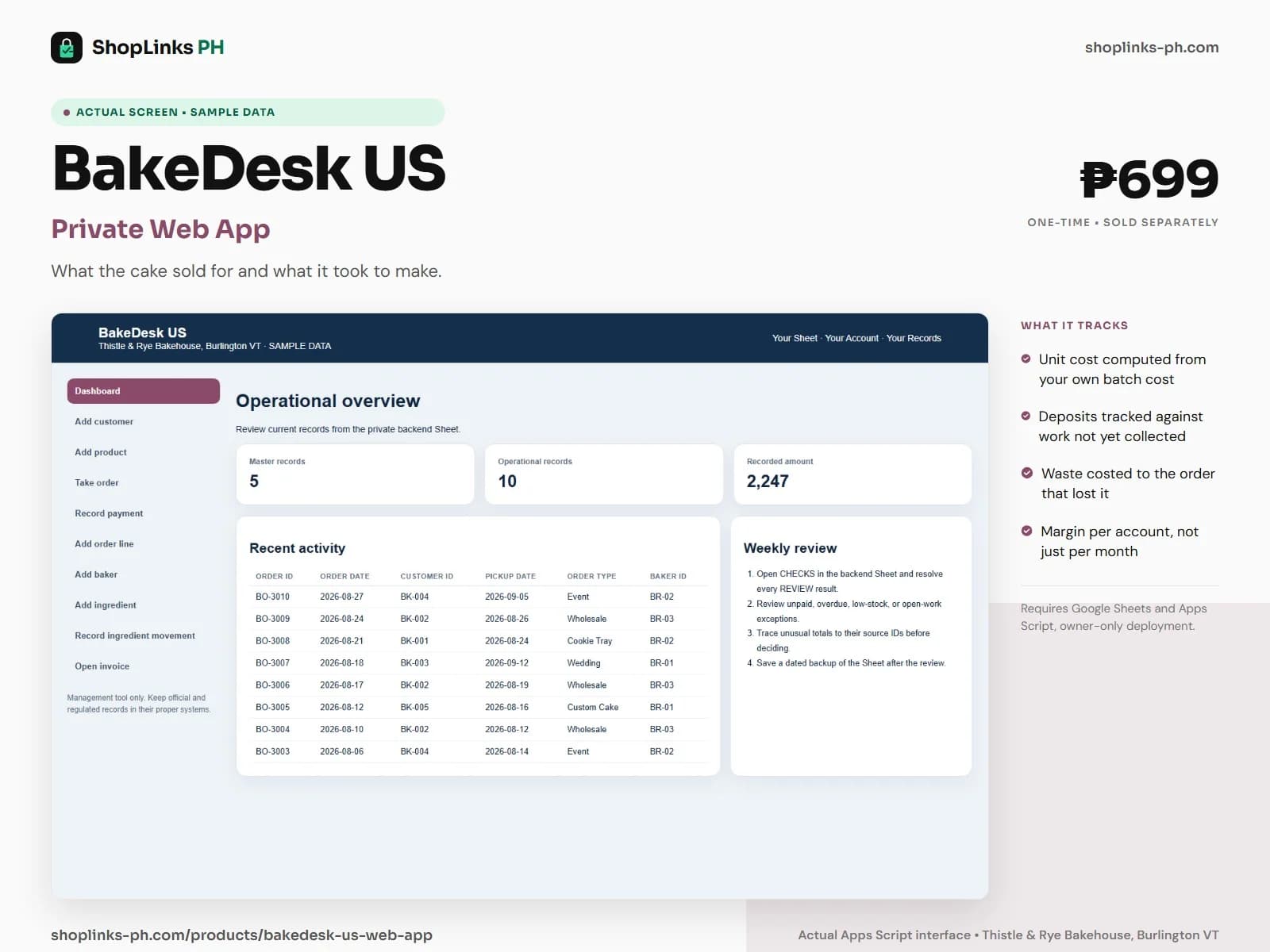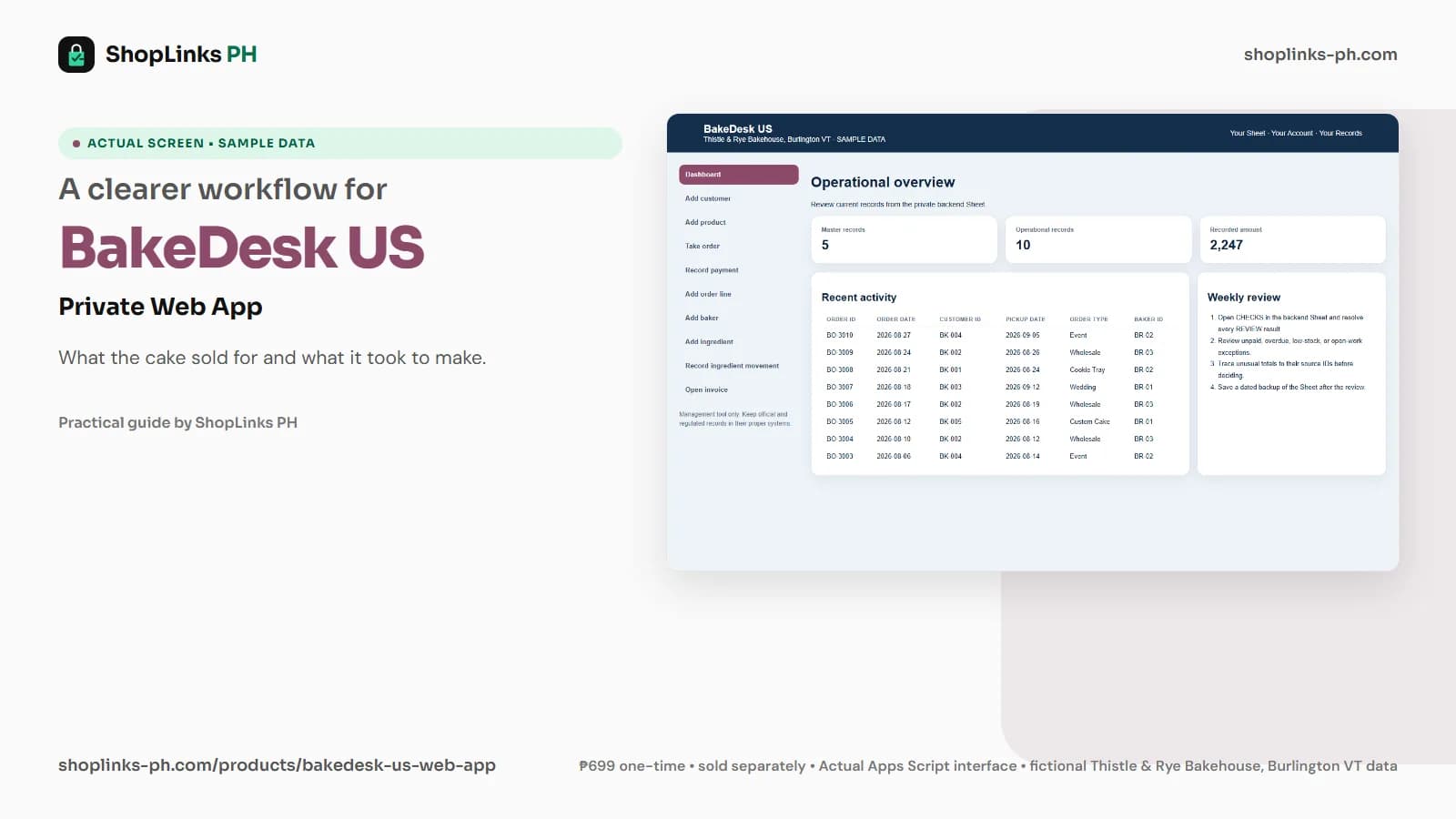
Key takeaways
- Unit cost comes from your own batch cost.
- Decorating hours are costed per baker.
- Deposits and balance due are tracked per order.
- Waste is costed to the order that lost it.
A custom bakery prices from a list and delivers from a decorating bench. The eight inch cake on the price list takes three hours when it is smooth buttercream and five when it is hand painted, and the list does not know the difference. Add wholesale pastry at a discounted rate and a wedding cake quoted three months ahead, and a bakery can be fully booked and barely profitable. BakeDesk US costs the order rather than the price list.
Cost per unit, from your own batch
A product records its batch size and the ingredient cost of that batch, and the unit cost follows.
This makes a tray of two dozen croissants and a single tiered cake directly comparable, which a price list alone never does.
Decorating hours are the real variable
Each order records the hours actually spent and the baker who spent them, so labor cost reflects a head baker hand painting rather than an assistant boxing a wholesale run.
On custom work this is almost always the largest cost, and it is the one most often left out of a quote.
Deposits against work not yet done
An order carries the deposit required and the deposit actually taken, and the balance due is computed from the order total.
Read across the board this answers a question every bakery has in wedding season: how much of the money in the account is already owed as cake.
Waste belongs to the order
A batch discarded for over-proofing is recorded as waste against the order it was baking for, so that order carries its true cost.
Bakeries lose real margin here and almost never measure it, because waste never appears on a supplier invoice.
Review exceptions every week
Resolve duplicate IDs, missing links, overdue balances, negative amounts, and open operational items in CHECKS before using the dashboard for decisions.
BakeDesk US Private Google Sheets Web App is designed for use with a Google account, Google Sheets, and Apps Script, using owner-only deployment by default.
No cottage food or health department licensing records, no allergen or nutrition labelling, no online ordering storefront, no delivery routing, and no recipe scaling or production scheduling.