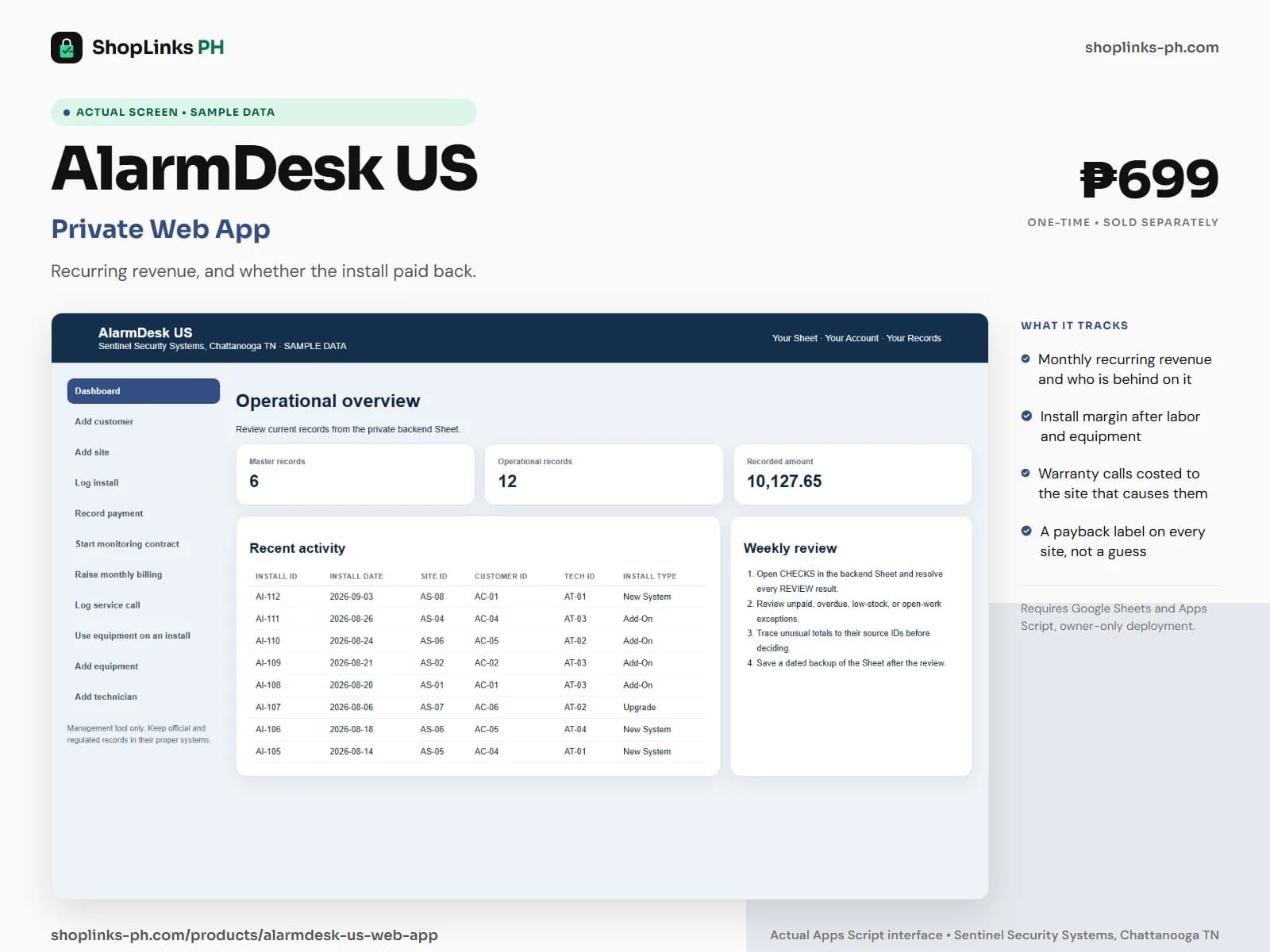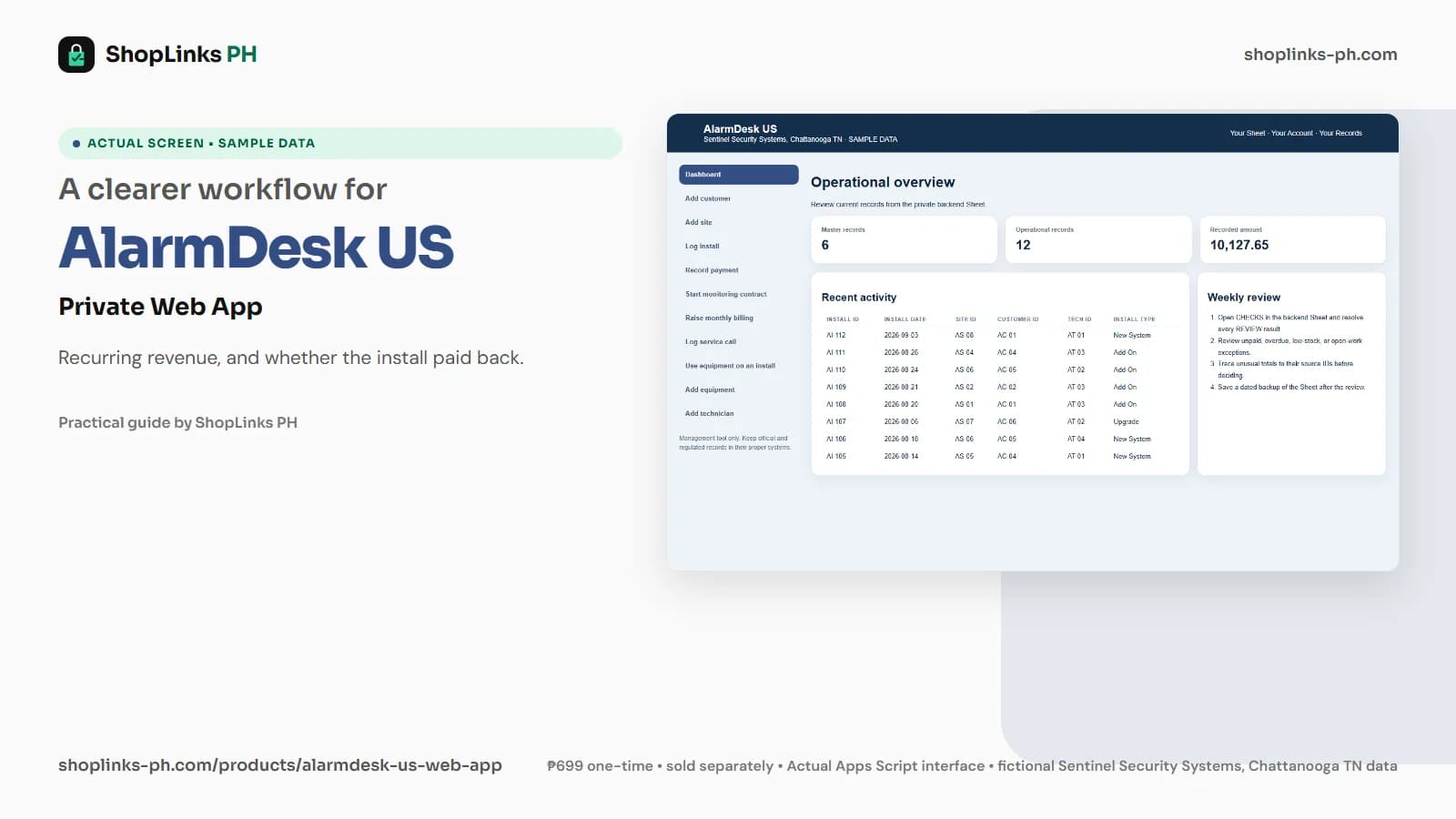
Key takeaways
- Install margin is priced after labor and equipment.
- A monitoring balance can never read negative.
- Warranty calls are costed to the site that caused them.
- Every site carries a payback label, not a guess.
Sentinel Security Systems gave away an install in August. A panel, five door contacts and six hours of a technician went into a house on Lookout Crest Lane for an activation fee of a hundred and ninety nine dollars, because the monitoring contract behind it runs three years. That is a good trade or a bad one depending on numbers nobody in the office was writing down anywhere.
The install is only half the deal
An install records the price quoted, any promotion discount and the equipment used. Labor hours are priced at the technician's own rate and the equipment carries a cost beside its sell price, so install margin is the real number, not the invoice.
A discounted install reads Loss in the check column and that is correct. It is supposed to. What matters is whether the contract behind it closes that gap, and that question belongs on the site, not on the install.
Monthly billing that cannot go negative
Each monthly billing takes its rate from the contract and subtracts any credit you applied. The amount due is floored at zero, so a credit larger than the month's rate leaves the line at nothing owed instead of a negative balance nobody can explain.
Payments post against the billing they belong to, the balance follows, and the contract rolls up months billed, money collected and money outstanding with a Current or Behind label beside it.
Warranty calls have a cost
A service call records the reason, whether it is under warranty, anything billable and the technician hours. Service cost comes from those hours at that technician's rate, so a no-charge visit still shows what it cost you.
Three false alarms on a free install is a pattern worth seeing. Each call lands on the site that generated it, so a cheap sale that runs expensive stops being invisible until renewal.
Has the install paid for itself
The site summary adds install margin, recurring margin and service margin into a lifetime value, then labels the site Still recovering, Paid back, Earning or No recurring so the answer is a word.
That label is the whole business in one line. It tells you which discounts are working their way back, which ones are not, and which sites simply earn month after month with nothing left to recover.
Review exceptions every week
Resolve duplicate IDs, missing links, overdue balances, negative amounts, and open operational items in CHECKS before using the dashboard for decisions.
AlarmDesk US Private Google Sheets Web App is designed for use with a Google account, Google Sheets, and Apps Script, using owner-only deployment by default.
No central station signal handling or alarm dispatch, no false alarm permit filing with the city, no technician licensing records beyond a Yes or No flag, no card processing or automatic recurring charges, and no camera video storage or live streams.