Key takeaways
- Convert purchases to consistent base-unit costs.
- Include labor, utilities, overhead, packaging, and selling fees.
- Price from sellable yield and a target margin, then validate against the market.
- Track actual sales and expenses and update costs regularly.
A busy order book does not always mean a profitable food business. If your price covers ingredients but leaves out packaging, labor, utilities, wastage, and selling fees, every sale can quietly reduce the money available to grow.
This guide gives home bakers, caterers, beverage sellers, food carts, and small restaurants a repeatable way to price products using their own numbers.
1. Standardize every ingredient cost
Convert each supplier purchase into one base-unit cost. If one kilogram of flour costs ₱68, its cost per gram is ₱0.068. If a recipe uses 350 grams, the flour cost is ₱23.80. Apply the same method to pieces, milliliters, packs, bottles, and trays.
Use the quantity actually purchased, including practical yield adjustments. A kilogram of whole produce may not provide a full kilogram of usable product after peeling or trimming.
2. Calculate the full batch cost
Add the ingredient costs for one standard batch. Then include batch-level labor, utilities, and overhead. Labor should represent the value of the time spent preparing, cooking, packing, and cleaning—even when the owner does the work.
Batch cost = ingredients + labor + utilities + allocated overhead.
3. Divide by sellable yield
Use the number of portions you can actually sell, not the ideal yield. If a batch costs ₱498 and produces 12 sellable boxes, the batch cost is ₱41.50 per box. Add packaging next. With ₱8 packaging, the direct cost becomes ₱49.50 per box.
4. Allow for percentage-based selling fees
Online marketplaces, delivery platforms, and payment methods may charge a percentage of the selling price. Because the fee changes with the price, use this formula:
Suggested price = direct cost ÷ (1 − target margin − platform fee rate).
For a ₱49.50 direct cost, 25% target margin, and 6% fee rate, the calculation is ₱49.50 ÷ 0.69 = ₱71.74. A practical listed price might be ₱72 or ₱75 after checking your market and portion value.
5. Check profit in pesos and as a margin
At a ₱75 price with a 6% fee, the fee is ₱4.50. Estimated profit is ₱75 − ₱49.50 − ₱4.50 = ₱21.00. The estimated profit margin is 28%.
Always review both measures. Peso profit tells you what one sale contributes; margin makes products easier to compare.
6. Record actual sales and expenses
A costing estimate is only the starting point. Track quantities sold, discounts, refunds, actual fees, ingredient purchases, utilities, transport, marketing, and other operating expenses. Compare estimated product profit with monthly net profit.
7. Update costs regularly
Review supplier prices whenever you restock and at least monthly for frequently changing ingredients. A linked system lets one price update flow into every recipe that uses that ingredient.
A simple operating routine
- Update ingredient purchases and base-unit costs.
- Confirm recipe quantities and sellable yield.
- Enter labor, utilities, packaging, fee rate, and target margin.
- Review suggested price and profit per serving.
- Record daily sales and expenses.
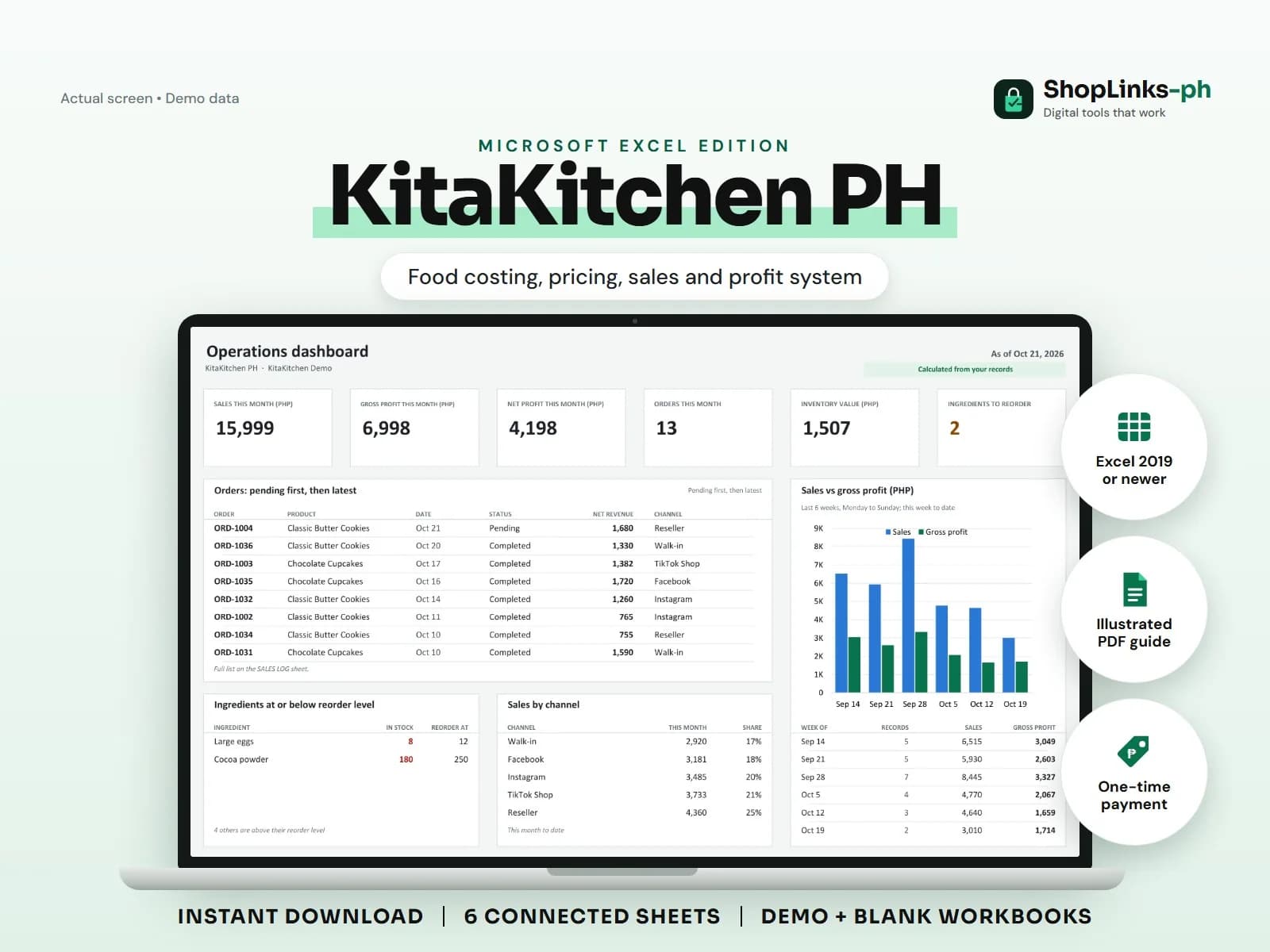
- Check the dashboard weekly and investigate low-margin products.
KitaKitchen PH Excel Edition puts this workflow into one connected Microsoft Excel workbook with an illustrated, edition-specific setup manual.
Figures produced by any template depend on the accuracy and completeness of the information entered. This article and the product are educational planning tools, not accounting, tax, legal, food-safety, or financial advice.