Updated for 2026. SSS, PhilHealth, and Pag-IBIG contribution rates reflect the latest schedules. This guide is for educational purposes — not a substitute for a financial advisor.
The real reason Filipino families run out of money before the 25th
It's not that you earn too little. (Although a raise never hurts.) It's that most households manage money reactively — you know roughly what comes in, you pay what's urgent, and you find out how much is left only when you check your GCash balance at the end of the month.
The three leaks that drain most PH households:
- Bills creep. Your Meralco bill, water, internet, Netflix, Spotify, Disney+, mobile plan, cable — individually they feel small. Together they quietly eat ₱5,000–₱12,000 a month and you've never added them up.
- The 13th month blind spot. Once a year, ₱15,000–₱40,000 arrives in December and disappears into Christmas, utang, and impulse buys — instead of going to debt payoff or a tuition sinking fund.
- No plan for the big-ticket irregulars. School enrollment hits in May. Christmas hits in December. Car registration hits in January. None of these are surprises — but without a sinking fund, they become emergencies every single year.
A proper household budget doesn't require earning more. It requires seeing the full picture before payday, not after.
Part 1: Understanding your real take-home pay
Gross vs. net — the mandatory deductions every PH employee has
When your employer says your salary is ₱30,000, that's your gross. Before it hits your bank account, three agencies take their mandatory shares:
| Agency | Employee share | On a ₱30,000 salary |
|---|---|---|
| SSS | 4.5% of MSC (capped at ₱1,125/mo) | ₱1,125 |
| PhilHealth | 2.5% of basic salary (employee share of 5% total) | ₱750 |
| Pag-IBIG | 2% (max ₱100/mo) | ₱100 |
| Total mandatory | ₱1,975/mo |
That's nearly ₱24,000 a year leaving your paycheck before you see it. Budget from your net take-home, not your gross. Pull out your payslip and use the actual deduction numbers — not approximations.
Allowances: taxable or not?
Transportation, meal, and rice allowances are common in PH employment contracts. Under current TRAIN law:
- De minimis benefits (rice subsidy up to ₱2,000/mo, meal allowance up to ₱2,000/mo, laundry up to ₱300/mo) are tax-exempt.
- Allowances above these thresholds are taxable as part of gross income.
- COLA (cost-of-living allowance) granted by law is tax-exempt; employer-given COLA above minimum wage workers' exemption may be taxable.
For budgeting purposes, include all allowances as income. Your tax exposure is a separate calculation.
Part 2: The 13th month pay — plan it, don't blow it
How it's computed (PD 851, 2026)
The 13th month pay formula is straightforward:
13th Month = Total Basic Salary Received in the Calendar Year ÷ 12
Key rules:
- Only basic salary counts — overtime, allowances, bonuses, and night differential are excluded.
- It must be paid on or before December 24.
- Up to ₱90,000 is tax-exempt under TRAIN law (this covers most employees).
- If you started mid-year (say, July), you only count July–December basic pay ÷ 12. You still get it.
What to do with your 13th month instead of spending it all
Most Filipinos treat the 13th month as a bonus. Financially, it's a planned annual inflow — and the best families treat it like a strategic allocation, not a windfall.
A practical split for a family with debt:
- 50% → highest-interest debt payoff (credit card balances)
- 25% → January to March cash buffer (bills, school enrollment, registration)
- 15% → Christmas and Noche Buena (yes, allocate for it — it's non-negotiable in PH culture)
- 10% → emergency fund top-up
If you're debt-free: split between emergency fund, school tuition sinking fund, and a family treat. You've earned it.
Part 3: Bills tracking — the boring part nobody does until it hurts
The average Filipino household's monthly bill stack
| Bill | Typical range (Metro Cebu / Metro Manila) |
|---|---|
| Meralco / VECO (electricity) | ₱800 – ₱4,000 depending on aircon use |
| Water (MCWD / MWSS) | ₱250 – ₱800 |
| Internet (fiber: PLDT/Globe/Converge) | ₱1,299 – ₱2,499 |
| Mobile postpaid | ₱499 – ₱1,499 |
| Netflix | ₱149 – ₱549 |
| Spotify / Apple Music | ₱149 – ₱199 |
| LPG (11kg tank × refills) | ₱600 – ₱1,200 depending on cooking frequency |
Add rent (₱5,000–₱18,000 for a decent unit outside the city center) and your bills alone hit ₱10,000–₱25,000 before you buy a single grocery item.
The fix: list every bill with its due date. Set aside the total at the start of each month. Stop treating bills as surprises — they are fixed costs that arrive on schedule.
Part 4: SSS, PhilHealth, and Pag-IBIG — what you're actually building
SSS (Social Security System)
Your monthly SSS contribution funds:
- Retirement benefit (at age 60/65 with minimum 120 contributions)
- Disability, death, and funeral benefits
- Salary and calamity loans (requires active contributions)
- Maternity and sickness benefits
2025 employee contribution rate: 4.5% of your Monthly Salary Credit (MSC). Maximum employee share: ₱1,125/month (at MSC ₱25,000). Employer pays an additional 9.5%.
Important: If you took an SSS salary loan, your amortization is deducted from your monthly contributions. Track this separately — a missed amortization disqualifies your benefit eligibility.
PhilHealth
The 2025 premium rate is 5% of basic monthly salary, split equally: 2.5% employee, 2.5% employer. Minimum contribution: ₱250/month (employee share). Maximum: ₱2,500/month (employee share, based on ₱100,000 salary floor).
Your PhilHealth contributions fund inpatient and outpatient hospital coverage under the case rates system. The more consistently you contribute, the better your benefit eligibility.
Pag-IBIG (HDMF)
Pag-IBIG contributions fund your future housing loan eligibility. Employee share: 2% of compensation, capped at ₱100/month. Employer matches at 2%.
After 24 monthly contributions, you're eligible for a Pag-IBIG multi-purpose loan (for appliances, education, minor home repairs). After sufficient contributions + provident fund accumulation, you can apply for a housing loan.
Optional voluntary contributions: You can voluntarily contribute more than ₱100/month to grow your Pag-IBIG provident fund, which earns dividends. Many financial planners recommend ₱500–₱1,000/month voluntary contributions as a forced savings vehicle.
Part 5: Sinking funds — the Filipino family secret weapon
A sinking fund is simple: you set aside a fixed amount each month for a known future expense. When the expense arrives, the money is already there. No debt, no stress, no raiding the emergency fund.
Every Filipino household needs these sinking funds:
| Fund | Why | Target (typical) |
|---|---|---|
| Emergency Fund | Job loss, medical emergency, typhoon damage | 3–6 months of expenses |
| School Tuition | Enrollment opens in April–May every year | Full SY tuition ÷ 11 months |
| Christmas Fund | Noche Buena, gifts, aguinaldo, Media Noche | ₱10,000–₱25,000 |
| Car / Motorcycle | Annual registration + PMS every 5,000 km | ₱8,000–₱15,000 |
| Medical / Health | Dental, eye check, out-of-pocket meds | ₱1,000–₱2,000/month |
Pro tip: open a separate savings account or GCash GSave wallet per fund. Don't mix sinking funds with your everyday account — the money will disappear.
Part 6: Debt Snowball — getting out of the credit card trap
Credit card debt in the Philippines carries some of the highest interest rates in Asia: most cards charge 2–3% per month (24–36% annually). If you're paying only the minimum, you could be on the hook for 5–10 years on a single card.
How the Debt Snowball works
- List all debts: credit cards, SSS salary loan, Pag-IBIG MPL, personal loans, motorcycle loan.
- Sort smallest balance to largest.
- Pay the minimum on every debt except the smallest.
- Throw every extra peso at the smallest debt.
- When debt #1 is gone, add its full payment to debt #2's minimum. Repeat.
The snowball builds momentum because you free up cash with each eliminated debt. The psychological wins keep you going when it gets hard. It's not the most mathematically optimal method (that's the Debt Avalanche, targeting highest interest first) — but it's the most proven for staying motivated through the payoff journey.
What about credit card minimum payments in the Philippines?
Philippine banks set minimums at 2–5% of the statement balance, or ₱500, whichever is higher. At 3% interest per month, paying only the minimum means you're barely covering the interest charge. Aim to pay at least 3× the minimum on your highest-interest card while maintaining minimums on the rest.
The shortcut: use the tracker we built
You can build all of this in a blank spreadsheet. It will take you a weekend, and you'll probably get the PhilHealth formula wrong the first time, forget to make the 13th month row work correctly, and end up with disconnected sheets that you stop opening after two months.
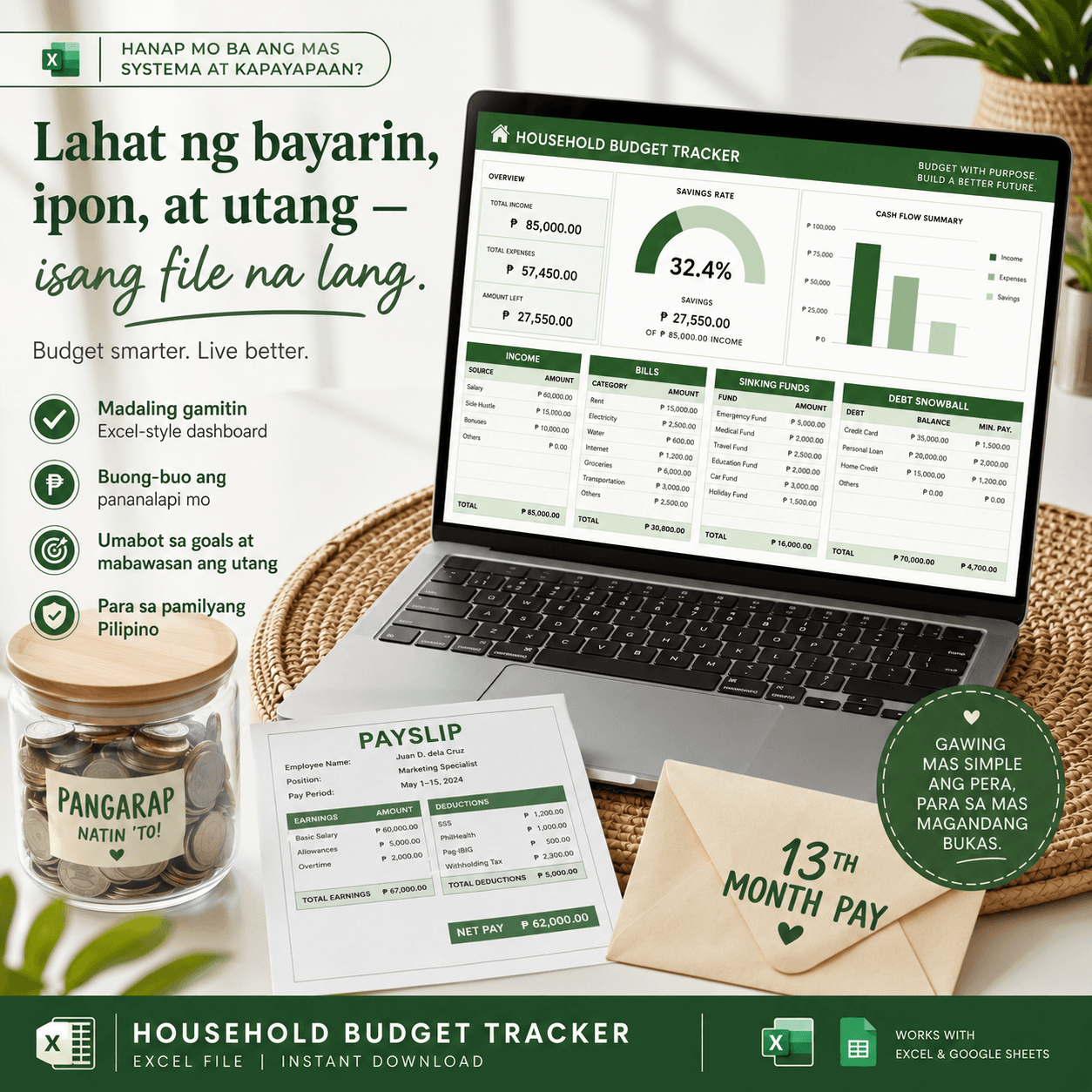
We built the version we wish existed when we started. One Excel file, 9 connected sheets, all formulas wired together.
- Settings — household name, budget year, earner names. Drives everything else.
- Income — 3 earners, 12 months, 13th month auto-filled in December, annual total per source.
- Bills — every bill with Jan–Dec columns, due dates, and monthly totals.
- Govt Contributions — SSS, PhilHealth, and Pag-IBIG per earner. PhilHealth auto-computes from your basic pay; SSS and Pag-IBIG are editable to match your actual payslip.
- Sinking Funds — 9 goal slots with target amount, target month, monthly allocation, and progress bars.
- Debt Snowball — list all debts; NPER formula estimates months to payoff. Interest rates above 2%/month are highlighted red.
- Dashboard — this month's income, bills, contributions, and savings rate — auto-updated from the other sheets.
- Reference — full SSS, PhilHealth, and Pag-IBIG contribution tables for 2025–2026.
One-time payment: ₱199. Works in Excel and Google Sheets offline. No subscription. No login. Yours forever.
Download the Household Budget Tracker — ₱199
Instant download via email. PayMongo checkout (GCash, Maya, QR Ph, card). 7-day download link.