Key takeaways
- One standard moisture percent per commodity, applied to every lot.
- Gross weight minus the deduction gives net weight.
- Net weight times price per kilo is the farmer's payout.
- Hauling belongs in cost per kilo, not in month-end expenses.
Watch the supporting video
Watch the YouTube guide here while following this article.
A buying station runs on two numbers written on a scrap of paper: the weight on the scale and the moisture reading. Everything after that, the deduction, the payout, the hauling, and whatever the mill eventually pays, is done in someone's head. By the time the truck leaves, nobody can say which lot earned and which one bought trouble. CopraDesk PH turns the weigh-in into a row that carries the deduction, the net weight, the payout, and the margin all the way through.
Set the standard moisture once per commodity
Each commodity carries a standard moisture percent, a buying price, and a selling price. The deduction on any delivery is the moisture reading less that standard, floored at zero, so a dry lot is never penalised and a wet lot is deducted the same way every time.
When your buyer changes the standard, you edit one cell and every new weigh-in follows it. The farmer can be shown the same rule on every visit, which is what stops the argument at the scale.
Let the weigh-in compute the payout
A delivery records the gross weight, the moisture reading, and the price agreed that day. Deduction percent, deduction kilos, net weight, and amount payable follow from those three inputs.
Net weight times price per kilo is what the farmer is paid, and that is the only figure the farmer needs to see. Payments are recorded against the delivery, so a partial payout leaves a visible balance rather than a promise.
Carry hauling into the cost
Hauling is entered on the delivery, not lumped into monthly expenses, so cost per kilo is amount payable plus hauling divided by net weight. That is the real landed cost of the lot in your bodega.
Margin per kilo is the commodity's selling price less that cost, and estimated margin is margin per kilo times net weight. A lot bought at a good headline price but hauled from far away shows a thinner margin immediately.
Close the loop with the mill
Sales record the buyer, the weight, the selling price, and trucking, and collections are logged against the sale. Balance is what the mill still owes you.
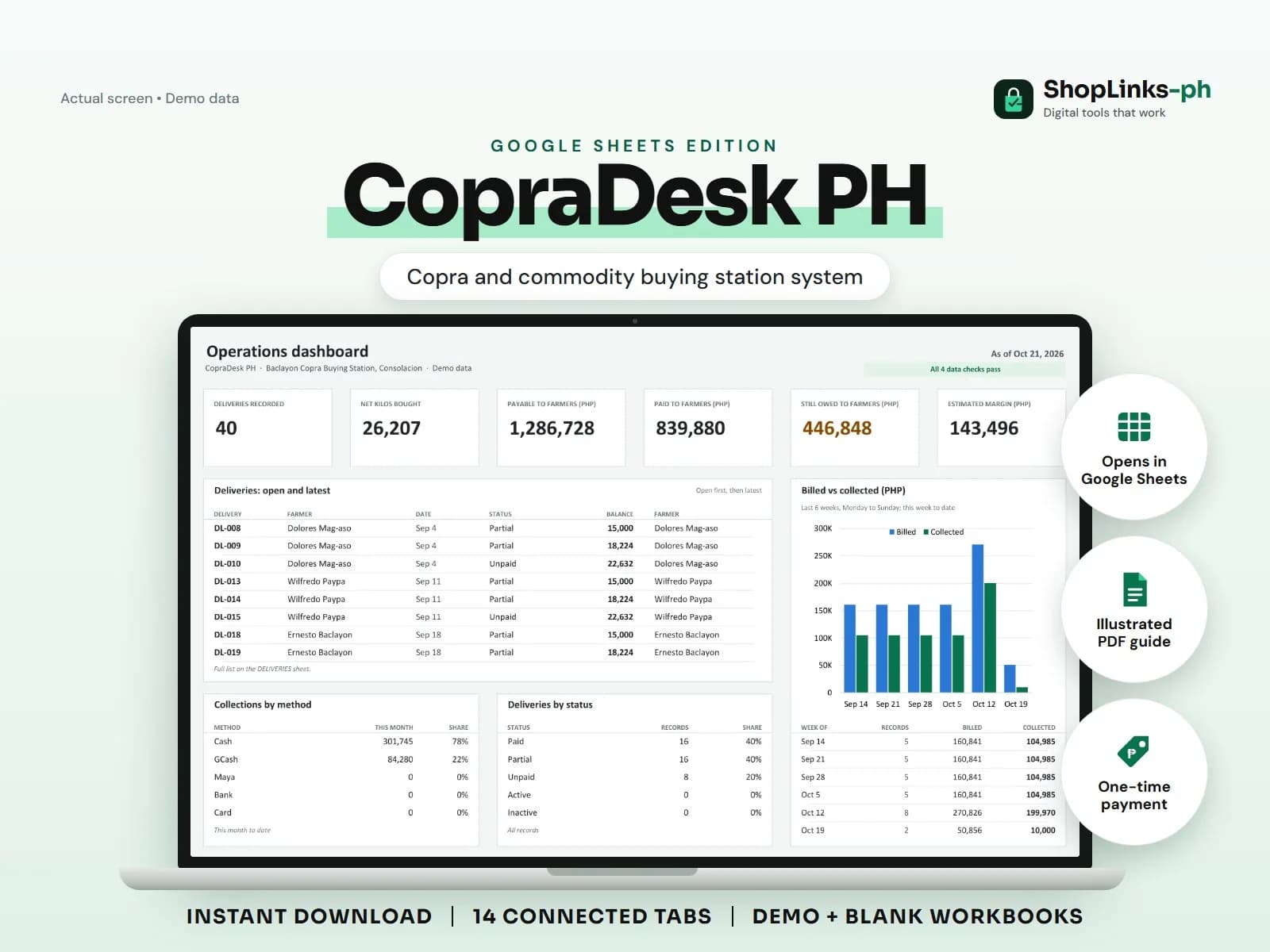
FARMER REPORT totals deliveries, net kilos, amount payable, paid, and balance per farmer, which is the list to work through on payout day. The dashboard shows net kilos bought, what is payable, what has been paid, what is still owed, and the estimated margin across all deliveries.
Review exceptions every week
Resolve duplicate IDs, missing links, overdue balances, negative amounts, and open operational items in CHECKS before using the dashboard for decisions.
CopraDesk PH Google Sheets Edition is designed for use with a Google account and current desktop Google Sheets.
No calibrated scale or moisture meter connection, no NFA, PCA or DA permit compliance, no commodity price feeds, no futures or hedging advice, no payroll, tax filing, or official receipts.