Key takeaways
- Member equity is capital paid plus savings balance.
- Check the limit before the loan is released, not after.
- A pending application carries no loan balance.
- One surplus row drives both dividend and patronage.
Watch the supporting video
Watch the YouTube guide here while following this article.
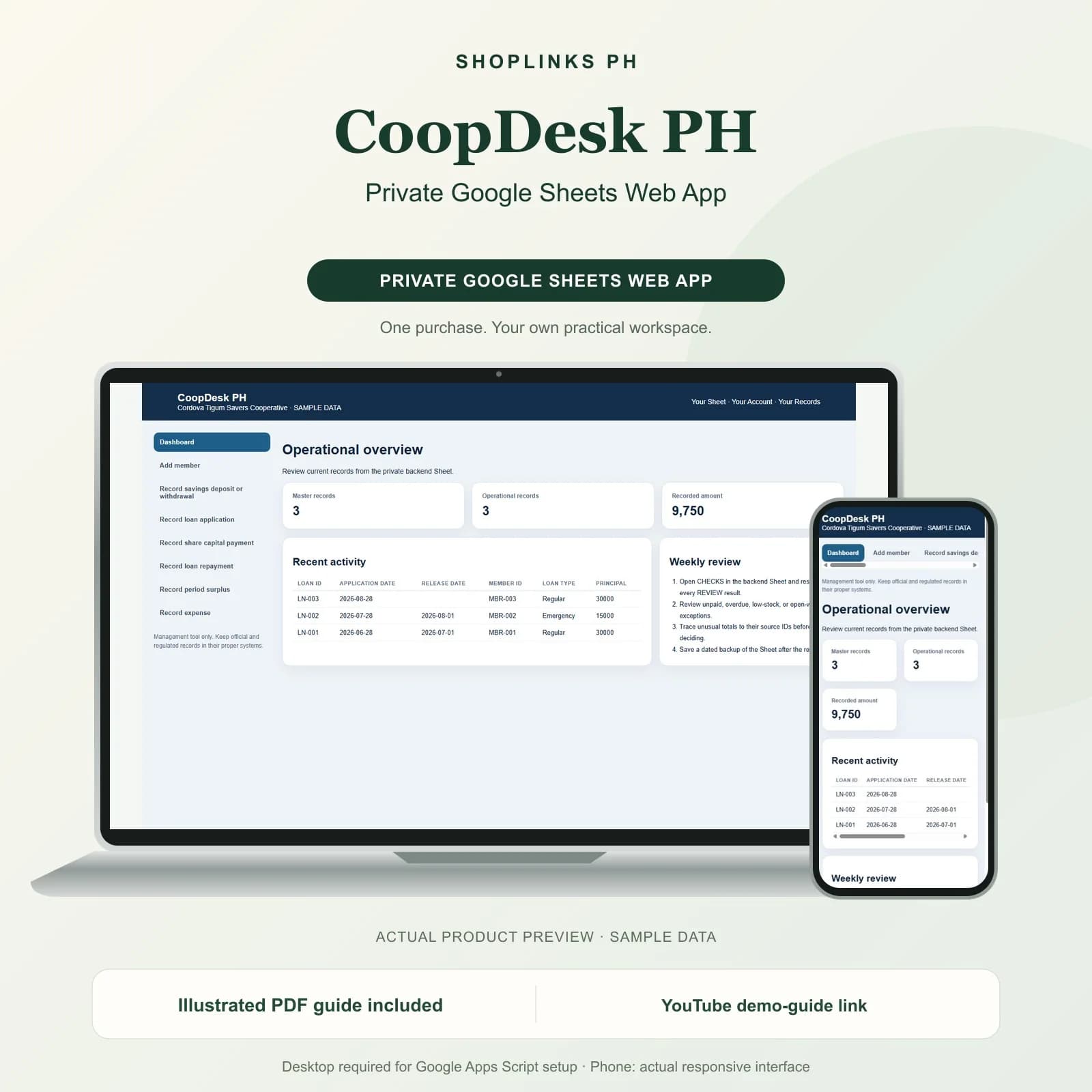
A small cooperative usually starts with one ledger book and a treasurer everyone trusts. It works until a member asks what their equity is, a loan goes out that the borrower's capital could never support, and the annual dividend has to be split without anyone being able to show the arithmetic. CoopDesk PH keeps share capital, savings, and loans on one board so member equity is a computed number rather than a recollection.
Build equity from two ledgers
Share capital payments and savings deposits and withdrawals are recorded as they happen, each pointing at a member ID. The member ledger adds capital paid to savings balance and calls the result member equity.
That single figure is what the rest of the sheet is built on, and it moves whenever a member pays in or draws out.
Check the loan before you release it
A loan is entered as an application with its principal, interest rate, and term. Interest, total payable, and monthly amortisation are computed, and the loan limit is set at three times the member's equity.
Limit check then reads Within limit or Over limit on the row itself, so the board is looking at the same number the borrower is, before any money leaves.
Let repayments close the loan
Repayments point at the loan ID, and the loan balance is total payable minus repayments. A loan still marked Pending or Rejected carries no balance, so an application never inflates what is outstanding.
Available to borrow on the member ledger is the loan limit less the balance already carried, which is the honest answer to the next request.
Split the surplus with arithmetic
One surplus row records interest income, service fees, and operating expenses for the period, and the dividend and patronage rates you agreed on. Net surplus, the dividend pool, the patronage pool, and the retained surplus follow.
ALLOCATION then divides the dividend pool by each member's share of paid capital and the patronage pool by their share of loan interest charged, so every member's figure can be traced back to a row.
Review exceptions every week
Resolve duplicate IDs, missing links, overdue balances, negative amounts, and open operational items in CHECKS before using the dashboard for decisions.
CoopDesk PH Private Google Sheets Web App is designed for use with a Google account, Google Sheets, and Apps Script, using owner-only deployment by default.
No CDA registration or reporting compliance, audited financial statements, statutory reserve computation, regulated dividend declaration, credit investigation, collateral appraisal, official receipts, or tax filing.